
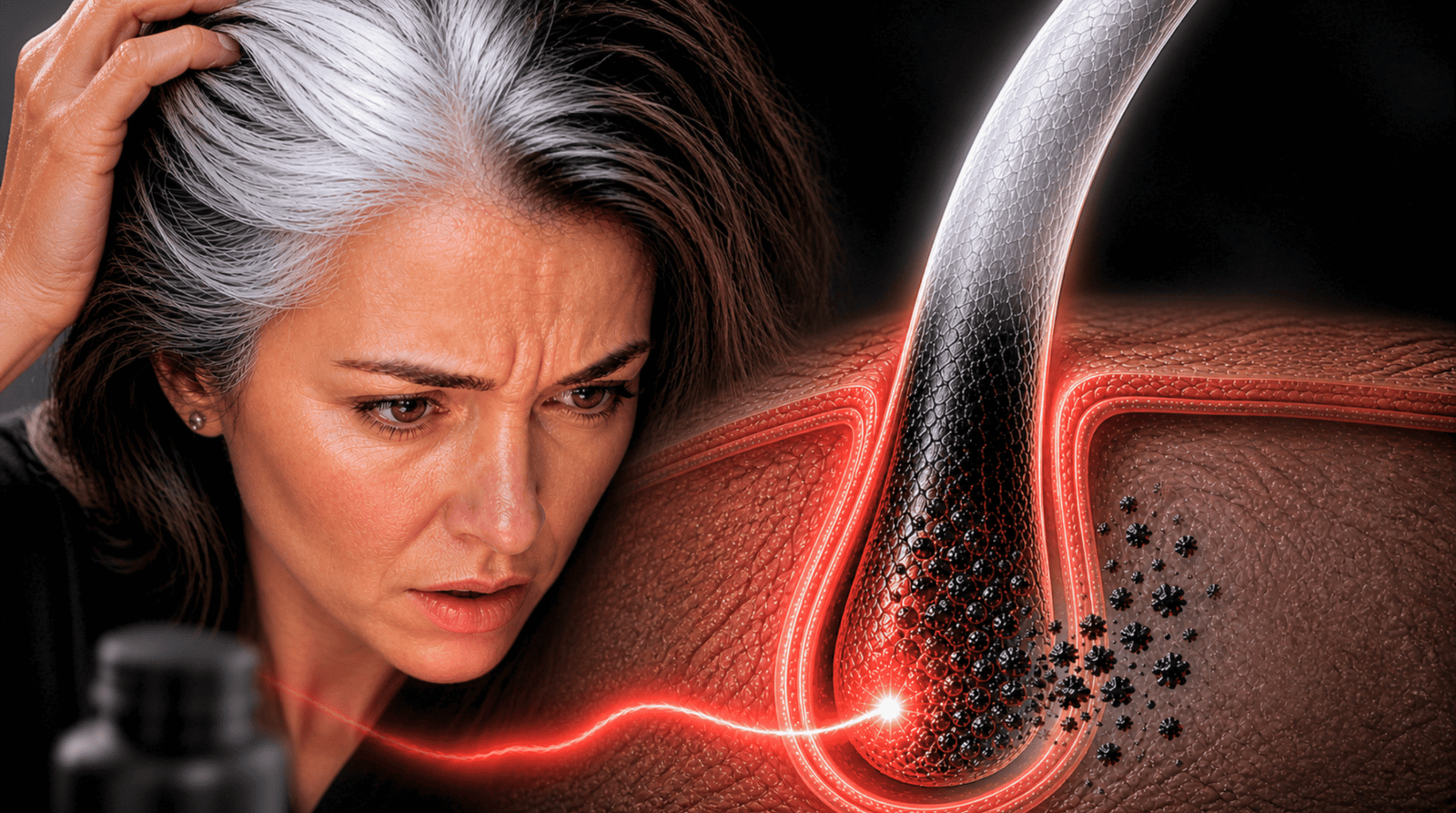


Have you noticed the explosion of products promising to reverse your gray hair? There is a multi-billion dollar industry built entirely on the fact that people hate seeing those silver threads. You’ll find supplements, serums, powders, oils, and pills all claiming to stop gray hair in its tracks. This is understandable. Gray hair carries a unique emotional weight. It is a visible and seemingly permanent sign of aging that often begins much earlier than we expect. The problem is that most of what is sold to you is simply exploitation of these feelings. It doesn’t solve the basic biology.
In this article, we’ll cut through the marketing hype and look at what science actually says about why your hair turns grey. You’ll learn what really affects this process and why the supplement industry’s answer is always the wrong answer. Instead of wasting money on false promises, you can focus your energy on things that have been proven to support your health from the inside out, which includes the health of your hair follicles. (Based on insights from Dr. Alex Webberley)
Key takeaways
- Biology of gray hair: Gray hair results from the depletion of melanocyte stem cells in hair follicles, which are responsible for producing pigment.
- Genetics vs lifestyle: While genetics determine the overall graying timeline, your lifestyle choices greatly influence how quickly this process occurs.
- Stress is a major factor: Both acute and chronic stress can rapidly deplete pigment-producing stem cells, permanently accelerating the graying process.
- The importance of diet and exercise: Eating a healthy diet and getting regular exercise fights oxidative stress, a major driver of aging that damages hair follicles and your entire body.
- Supplements are not the solution: Unless you have been diagnosed with a nutrient deficiency, supplements for gray hair are unlikely to work and are not supported by strong scientific evidence.
1. Basic Biology: The “ink cartridge” of your hair
To understand why hair turns gray, you first need to know what gives it color. Within each hair follicle on your head, you have specialized cells called melanocytes. Its job is to produce melanin, the pigment that colors your hair. But these melanocytes do not live forever. It must be constantly replenished by a special reserve of melanocyte stem cells, located in a certain part of the follicle. Think of these stem cells as the main reservoir for your hair color.
Every time new hair starts its growth cycle, your body pulls from this reservoir. the Stem cells Create new melanocytes, which then produce melanin, and your hair grows its natural color. Gray hair is what happens when this system breaks down. It’s like an ink cartridge that slowly stops refilling. When the supply of stem cells runs out, or when they are damaged or depleted too quickly, new hair grows with little or no pigment. This, at its simplest, is gray hair. All other factors – genetics, stress, diet – work through the same basic pathway.
2. Genetics is what moves the weapon, but lifestyle is what moves the trigger
There is no doubt that genetics is the biggest factor that determines when you will start seeing gray hair. If your parents went gray early, chances are you will too. Large-scale genetic surveys, known as genome-wide association studies, have identified specific genes (such as IRF4) that are directly associated with the timing of hair graying. It’s inherited, it’s real, and no supplement will change your genetic baseline.
However, this is where framing really matters. Your genes do not determine your destiny; They just put in a window of possibility. What you do in that window—how you live your life—can greatly impact how quickly you move through it. Imagine two identical twins with the same DNA and the same genetic predisposition to premature graying. One of the twins lives a very healthy lifestyle: they get good sleep, exercise regularly, eat a whole food diet, and control their stress. The other twin does not. Decades of research on twins shows that lifestyle factors can change life expectancy by 10 years or more among genetically identical people. The same biological processes that cause this difference also operate within the hair follicle. The healthy twin may still turn grey, but this is likely to happen later, more gradually, and against a background of a body aging more slowly in every important system.
3. How stress literally ages your hair
The most convincing evidence about how lifestyle affects gray hair comes from a landmark research paper published in nature In 2020. The researchers showed that acute psychological stress led to a rapid and permanent depletion of those precious melanocyte stem cells. The process was remarkably specific. Stress activates your sympathetic nervous system, your “fight or flight” response, which floods your hair follicles with a chemical called noradrenaline. This chemical explosion causes the stem cells to become over-activated and divide too quickly, burning out the reservoir much faster than occurs with normal aging.
Once those stem cells are gone, they are gone forever. The follicle permanently loses its ability to make new pigment cells, and every new hair it produces from that point on will turn grey. While this initial research was in animals, the mechanism goes straight to the biology of human stress. It offers a scientific explanation for what we’ve seen anecdotally for years: people reporting sudden appearances of gray hair during periods of extreme psychological stress. Chronic and unmanaged stress almost certainly plays a big role in accelerating the graying process.
4. The hidden damage of oxidative stress
It is closely related to psychological stress Oxidative stress. This is cellular damage caused by unstable molecules called free radicals. These molecules build up in your body much faster when you sleep poorly, eat a low-quality diet, don’t exercise, or live under chronic stress. Studies of human follicles have shown that this oxidative damage specifically targets melanocytes and their stem cells, impairing the body’s pigment production system over time.
But this process does not only affect your hair. The same oxidative stress that destroys your follicles simultaneously ages your arteries, damages brain cells, and leads to metabolic dysfunction in almost every organ system. Your hair follicles do not exist in a vacuum; It lives within the same biological environment as your heart and brain, and responds to the same inputs. This means that the things you do to protect your overall health also protect your hair color.
5. Your thorn is stronger than your pill
If oxidative stress is the main driver of gray hair, your diet is one of your most powerful tools to fight back. The PREDIMED trial, one of the largest nutritional intervention trials ever conducted, followed more than 7,000 people and showed that a Mediterranean-style diet significantly reduced systemic oxidative stress and cardiovascular risk compared to a standard low-fat diet. Likewise, the Lyon Nutritional Heart Study found that following a Mediterranean diet reduced the risk of a second heart attack in survivors by more than 70%.
These are landmark human experiments that show that the way you eat fundamentally changes the biological environment in which every cell in your body functions, including the cells responsible for pigmenting your hair. A diet rich in fruits, vegetables, healthy fats and lean proteins provides the antioxidants and anti-inflammatory compounds your body needs to protect itself from damage that accelerates aging, inside and out.
6. Exercise: Your body’s built-in defense system
The same logic applies to exercise. A 2019 meta-analysis of several randomized controlled trials found that aerobic exercise and regular exercise Resistance exercise Significantly reduces signs of oxidative damage and improves the body’s antioxidant defenses. The Family Heritage Study showed that a structured exercise program led to dramatic improvements in mitochondrial function, insulin sensitivity, and inflammatory markers — all of which are linked to cellular aging processes that affect your follicles.
Furthermore, exercise directly interferes with overactivity of the sympathetic nervous system nature Leaf stress has been identified as a major driver of stem cell depletion. It helps your body switch from “fight or flight” to “rest and digest” mode, reducing the flow of stress chemicals that damage your follicles. Unlike nutritional supplements, exercise improves every system in your body at once, from cardiovascular health to cognitive function, creating a healthier environment for your hair to grow.
7. The invisible cost of smoking
If you are looking for a habit that will speed up the appearance of gray hair quickly, smoking is at the top of your list. Multiple independent studies have found a consistent and strong relationship between smoking and premature graying, even after controlling for other factors such as age. The mechanism is the same one we always come back to: smoking dramatically increases oxidative stress throughout the body. It also impedes blood flow to peripheral tissues, including your scalp, depriving hair follicles of the oxygen and nutrients they need to function properly. If you smoke and are worried about going gray, the most effective thing you can do is stop.
8. When He is Nutrient Deficiencies (And How to Know for Sure)
While most nutritional supplements are useless in treating age-related graying, there are cases where a true nutrient deficiency can be the cause of premature graying. Deficiencies in vitamin B12, iron (ferritin), copper, and vitamin D, as well as thyroid dysfunction, have been associated with changes in hair color in the clinical literature. If you’re under 40 and your hair is graying quickly, it’s definitely worth getting a blood test from your doctor.
These problems are fixable, and correcting real and deliberate deficiencies can impact the process. However, this is fundamentally different from a healthy, well-nourished person taking a nutritional supplement to reverse age-related graying. The dietary supplement industry intentionally blurs this line because it is not in their financial interest to clarify the distinction. Instead of buying a bottle of pills that claim to boost your copper levels, get a blood test done. Your doctor can tell you if you are indeed deficient and prescribe what you need, or confirm that your levels are good, proving that a supplement is unnecessary.
Bottom line: Focus on what really works
Having gray hair is an emotional experience, and this is an emotion that the nutritional supplement industry reaps. The truth is that no supplement has robust, large-scale human trial data showing that it can consistently reverse or slow age-related graying in healthy adults.
What He does Our guide is a lifestyle. Eating a nutrient-rich diet like the Mediterranean style, getting regular exercise, getting enough sleep, not smoking, and managing your stress – this is what science says really works. The great thing is that these interventions are mostly free, and they don’t just work on your hair. They work on every biological system that determines how long you live and how well you live. The same choices that protect your heart and mind also protect your follicles. While genetics is a powerful force, your lifestyle can still make a difference. By focusing on your overall health, you’re not only delaying the appearance of gray hair; You protect your arteries, your cognition, and your metabolic flexibility for decades to come. Gray hair is just the visible surface of a much deeper biological process, and the tools that slow down this process do not come in a capsule.
source: Dr. Alex Webberley

