
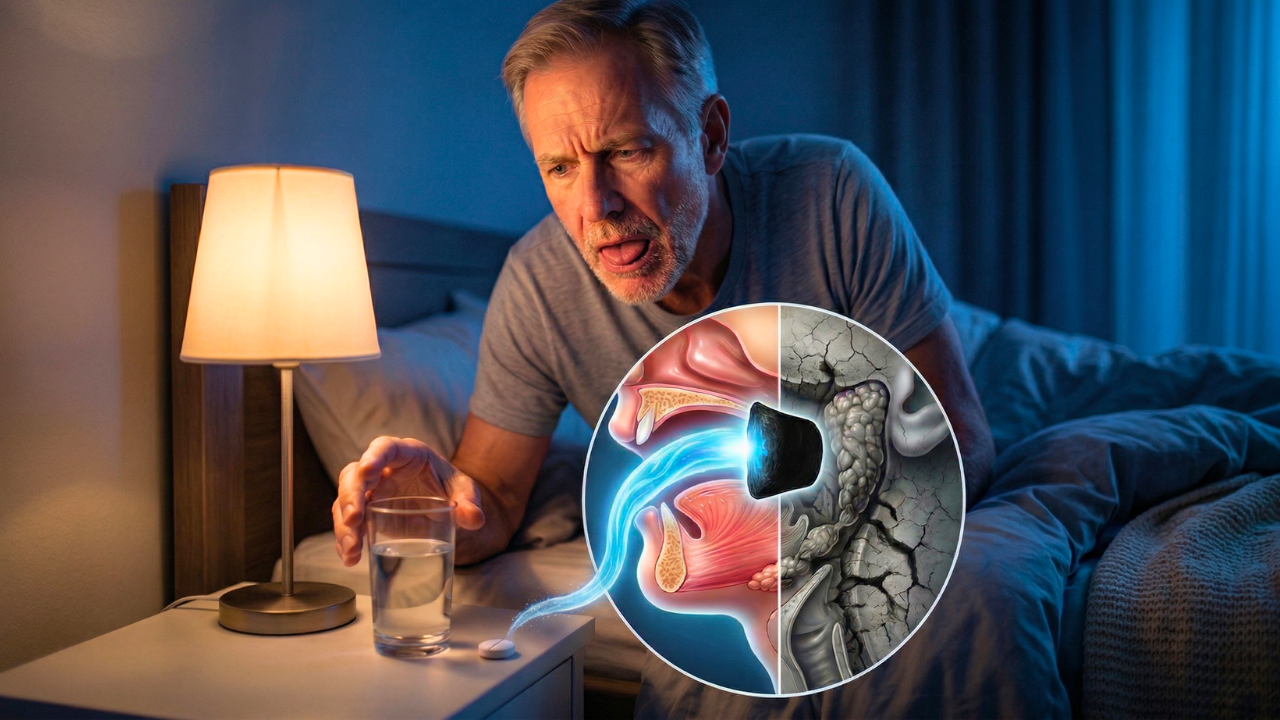

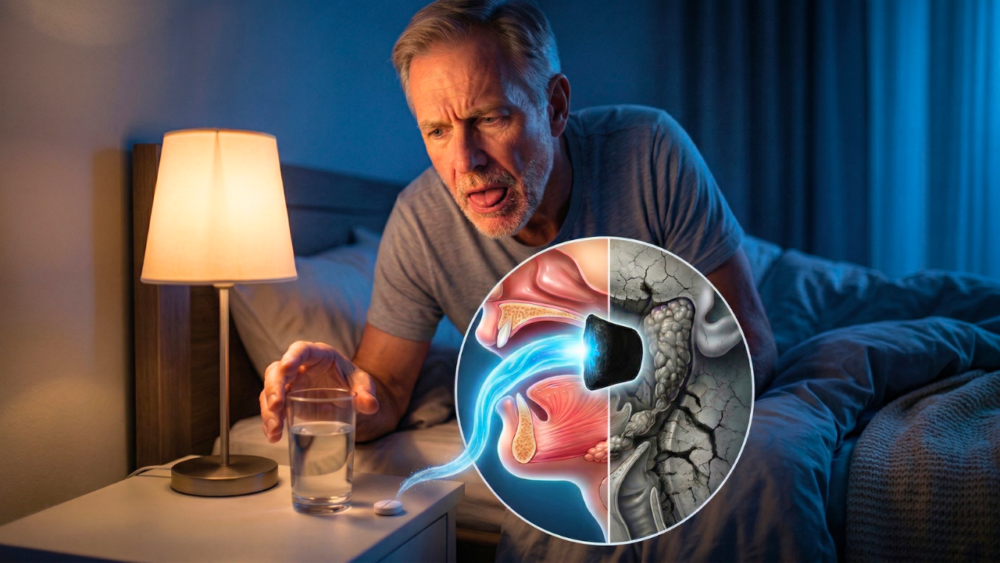
Does this sound familiar? You wake up at three in the morning, feeling like your tongue is stuck to the roof of your mouth, and your whole mouth feels musty, as if you’ve just swallowed a spoonful of sand. Your first instinct is to drink some water, but after ten minutes, that same dry, sandpaper feeling comes back with a vengeance. If this is your nightly reality, you’ve probably searched for solutions. You may have seen the popular advice to drink warm salt water first thing in the morning. Before you try it, please wait. This advice comes with a serious problem. If you take medication for your blood pressure or heart or even to help you sleep, taking extra sodium on an empty stomach can be like trying to put out a fire with gasoline — it can make things much worse, especially if you have high blood pressure or heart failure.
More importantly, the salt water hoax doesn’t address the real problem. To understand what’s happening to your dry mouth, imagine your salivary glands are like lawn sprinklers. The problem is not that the water tank is empty; It’s that someone has cut the wire that tells the sprinklers to turn on. Water is present, but the system does not receive the signal to start working. This is exactly what happens to many people over the age of 60 who wake up with a dry mouth. Dehydration is usually not the cause, although it can play a role. The real mystery we need to solve is the reason behind this. (Based on the insights of Dr. Alberto Sanagstín)
Key takeaways
- It’s not just dehydration: Waking up with a dry mouth is often caused by a problem sending signals to the salivary glands, not due to a lack of water in the body.
- Two main culprits: The problem usually stems from a “chemical obstruction” from common medications or a “mechanical obstruction” from breathing through the mouth during sleep.
- Medication issues: Many common medications (antidepressants, antihistamines, bladder control medications) have an anticholinergic effect that inhibits saliva production. The combined effect of many drugs can be significant.
- Breathing is the key: Nasal congestion or loss of muscle tone can cause mouth breathing, causing saliva to evaporate. This can also be a sign of a more serious condition such as sleep apnea.
- Actionable solutions exist: You can address the root cause by reviewing your medications with your doctor and taking steps to promote nasal breathing during sleep.
1. Understand the nocturnal shift of your saliva
To find out why your mouth is dry at night, you need to know something that few people realize about their saliva. Your body doesn’t produce the same type of saliva at 2 p.m. as it does at 3 a.m. There is a biological rhythm, or circadian clock, that significantly reduces saliva production during sleep. Think of it like a factory that switches to a skeleton crew to work the night shift. It doesn’t turn off completely, but it works at an absolute minimum. This is completely normal.
The problem arises when this natural low point is combined with something else, something that pushes the system further down when it is already at its lowest levels. This “something” could be one of two things, and the solution for you depends entirely on which one it is. The first is A Chemical blockageIt is something that interrupts the nerve signal that orders the glands to produce saliva. The second is A Mechanical blockageIt is the thing that evaporates what little moisture remains during sleep. Let’s take the first one, because it’s the most common and the most overlooked.
2. The first reason: chemical blockage in your medicine cabinet
Remember the garden sprinkler analogy to a cut wire? This wire represents your parasympathetic nervous system. Every night, this system sends a signal to the salivary glands via a neurotransmitter called acetylcholine, telling them: “Produce saliva. Keep the mouth moist.” The problem is that a very common group of drugs directly blocks this messenger. They don’t do it to upset you; It’s an unintended side effect of their main function. But the result is the same: the wire is cut, and the glands do not receive the command to produce saliva.
These are called medications AnticholinergicsMany people take it without knowing that it has this effect. The most common include:
- Older antidepressants: Drugs such as amitriptyline and clomipramine have a strong anticholinergic effect. You may be taking it at night to treat chronic pain or to help with sleep, which makes it a major concern.
- First generation antihistamines: They are often used to treat allergies or itching, and can effectively close the saliva spout.
- Overactive bladder medications: Medicines such as solifenacin or oxybutynin act on the same receptors that control saliva. It relaxes the bladder while at the same time cutting off the signal to the salivary glands.
- Diuretics: Medicines such as hydrochlorothiazide and furosemide reduce the total volume of fluid in the body. With less fluid available, saliva production decreases, especially at night when you haven’t been drinking for hours.
Do you take any of these? Here’s something that changes everything: You don’t need to take one powerful drug. Stunning data reveal that when several drugs that each have a mild anticholinergic effect are combined, the resulting dehydration can become severe. Think of it as a shotgun blast instead of a single bullet. One pill may not do much, but all together certainly will. Blood pressure pills may have a mild effect. The occasional antihistamine, muscle relaxant, and low-dose antidepressant, each seems innocent in itself. But when you put them all together at night, when natural saliva flow is at its lowest, the result is a mouth that looks like cardboard. The sum is often more important than any single part.
3. The second reason: mechanical obstruction resulting from how to breathe
The second major reason is not in your medicine box; It has to do with how you breathe while you sleep. Many people have no idea what is happening to them because they are unconscious when it happens. Think about what happens if you leave the refrigerator door open all night. By morning, everything inside will be dried. This does not mean that the refrigerator has stopped working; The thing is, the air was constantly circulating for hours, ruining the contents. The same thing happens to someone who sleeps with his mouth open. The air flows in and out for seven or eight hours, evaporating every trace of moisture that the glands have managed to produce. It doesn’t matter how much water you drink before bed; If you sleep with your mouth open, you will almost always wake up with your mouth open Dry mouth.
So why do people sleep with their mouths open? The most common cause is a problem with the nose. You may have a deviated nasal septum, nasal polyps, chronic rhinitis, or allergies. If your nasal passage is blocked, your body will find the path of least resistance, and that path is your mouth. The second reason, which particularly affects people over the age of 55, is the natural loss of throat muscle tone during sleep. The muscles relax more, the jaw drops, and the mouth opens. This is especially common in people who snore and is also a major sign of snoring Sleep apnea. If you already use a continuous positive airway pressure (CPAP) machine to treat sleep apnea, the machine itself may dry out your mouth if the humidifier is not adjusted properly, which is something you should discuss with your specialist.
4. How to know which blockage is affecting you
So, is your dry mouth caused by a chemical or mechanical obstruction? Ask yourself these questions to find out:
- Do you take two or three (or more) medications chronically? If so, a chemical blockage of your medications is a prime suspect.
- Do you snore at night or wake up feeling tired and inactive? If yes, the cause is likely mechanical, related to mouth breathing.
- Could it be both? For people over 60, it’s more common than you might think to have a combination of both problems – taking too many medications as well as snoring or sleeping with your mouth open. Defining your situation is crucial to knowing your next step.
5. Your practical plan to combat dry mouth tonight
Now for the good part: What can you do about it? Here are two steps you can take starting today, plus an important warning sign to watch out for.
Step 1: If you suspect a chemical blockage
Your job is to review your medication list with your doctor. Never stop or change medication on your own. This is the most important rule. What is with you He can What you should do is go to your doctor’s appointment prepared with a specific question. Say: “Doctor, I have very dry mouth at night. Could any of the medications I’m taking cause this?” You can also ask: “Is it possible to transfer any of my nighttime medications to the morning?” This is a great way to start the conversation. In some cases, the solution may be as simple as changing the time you take your pill, rather than the dose or medication itself. The logic is strong: If your saliva factory is already running on a skeleton crew at night, it doesn’t make sense to pile on medications that slow it down even more.
While you wait for this appointment, you can try some over-the-counter treatments. Chewing sugar-free gum, especially gum containing xylitol, stimulates the salivary glands and helps protect tooth enamel from decay, a major risk in chronic dry mouth. You can also try mouth moisturizers, which come in the form of sprays or gels from the drugstore. A sip of water evaporates quickly, but these products are designed to adhere to mouth tissue and provide long-lasting relief.
Step 2: If you suspect a mechanical blockage
The goal here is to restore airflow through its natural path: your nose. Start by rinsing your nose with a simple saline solution before bed. This can often open the passages enough so that your body no longer resorts to mouth breathing. Try sleeping on your side, which reduces the tendency for your jaw to drop and can also reduce snoring for most people. Placing a pillow between your knees can make side sleeping more comfortable. If you always wake up tired for no reason, snore loudly, or your partner says you stop breathing during your sleep, ask your doctor to perform a sleep study. Untreated sleep apnea is a serious cardiovascular risk and should be ruled out.
6. Red flags: When dry mouth indicates a deeper problem
In some cases, dry mouth isn’t just about taking pills or breathing. It could be a warning sign of an underlying condition that needs medical evaluation. You should see a doctor if:
- Your dryness does not improve after you make some of these adjustments.
- You also have persistent dry eyes, which can make you feel gritty. This may be a sign of Sjögren’s syndrome.
- She suffers from extreme thirst, frequent urination, and extreme fatigue. These are classic symptoms that can indicate diabetes.
- You have a history of radiotherapy to the head or neck, which requires specialist management.
This is not meant to alarm you, as the vast majority of cases are manageable. But trying to treat only the symptoms while the root cause remains active is illogical.
Conclusion: Take action tonight
Here’s something simple you can do today. Tonight, when you take your medications, look at each medication and ask yourself three questions: First, do I know exactly what this is for? Secondly, how long do I take it? And third, do I take this at night because it is He should To be taken at night, or just because I’ve always done it that way? If you don’t have a clear answer to any of these questions, you know what to do: Start a conversation with your doctor. Dry mouth may be the first sign of an imbalance, and by investigating the cause, you’re taking a powerful step toward better health.
source: Dr. Alberto Sanagstín

