
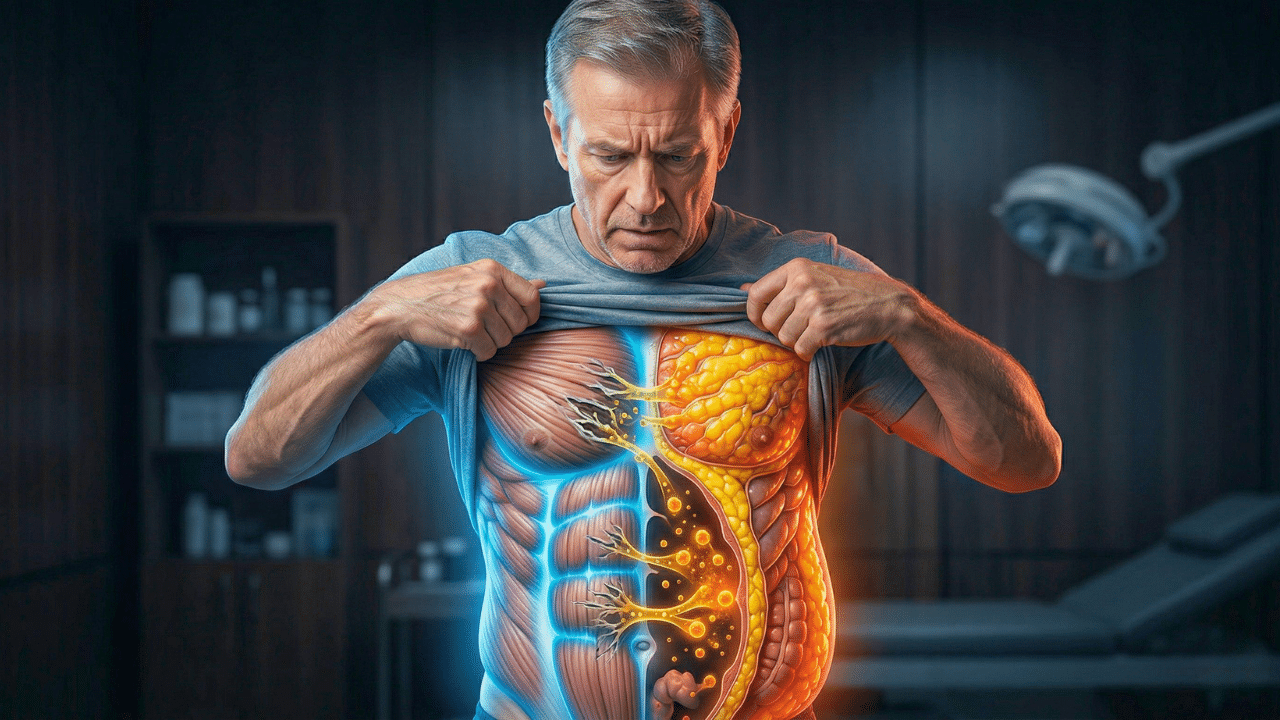


A new long-term study reveals that individuals over the age of 50 who have high levels of abdominal fat and low muscle mass face an 83% greater risk of death than their peers without these conditions. This dangerous combination, known as sarcopenic obesity, can be detected more easily than previously thought, offering hope for early interventions.
Key takeaways
- The presence of abdominal obesity and low muscle mass after the age of 50 increases the risk of death by 83%.
- Abdominal obesity alone does not significantly increase mortality if muscle mass is preserved.
- Simple clinical measures, such as waist circumference, can help detect this high-risk pattern early.
- Early detection can lead to effective interventions, including resistance training and nutritional changes.
Understanding sarcopenic obesity
Sarcopenic obesity describes a condition in which muscle mass decreases while body fat increases, especially around the abdomen. This double threat is especially common in older people. It is associated with decreased mobility, increased weakness, and increased likelihood of falls and chronic diseases. New research confirms the significant impact this combination can have on long-term survival.
How was the study conducted?
The findings are based on 12 years of data from more than 5,400 adults aged 50 and over who participated in the English Longitudinal Study of Ageing. Researchers from the Federal University of Sao Carlos in Brazil and University College London analyzed the relationship between body composition and mortality.
Their analysis revealed that individuals with a waist circumference greater than 102 cm (men) or 88 cm (women) and a low skeletal muscle mass index faced an 83% risk of death. Interestingly, those with low muscle mass but no abdominal obesity were found to have a 40% lower risk of death compared to the control group. Participants with abdominal obesity but normal muscle mass did not experience a higher mortality rate, highlighting the specific risk of the joint condition.
Why is this combination so dangerous?
When excess belly fat Muscle loss When they occur together, they trigger a chronic inflammatory process that accelerates muscle breakdown and disrupts basic metabolic and immune functions. Excess fat may infiltrate muscle tissue, weakening its strength and quality. Combined, these effects are far more harmful than either condition alone and can significantly impact independence and quality of life in older adults.
Simple screening methods for early detection
Until now, the diagnosis of muscular obesity has required expensive imaging techniques such as magnetic resonance imaging and computed tomography. This new research shows that simpler methods – such as measuring waist circumference and estimating muscle mass using clinical variables such as age, gender, weight and height – can serve as reliable screening agents.
This practical approach enables doctors to identify individuals at risk without high-tech tools, allowing more people to benefit from early interventions such as resistance training, targeted nutrition, and weight management strategies.
What can be done?
Healthcare professionals are encouraged to routinely evaluate both abdominal fat and muscle mass in older patients, not just weight or BMI. Interventions that combine strength training, adequate protein intake, and personalized nutritional support can help prevent or reduce morbid obesity, which may reduce the risk of premature death. These findings give new importance to promoting physical activity and healthy eating throughout the aging process.

