
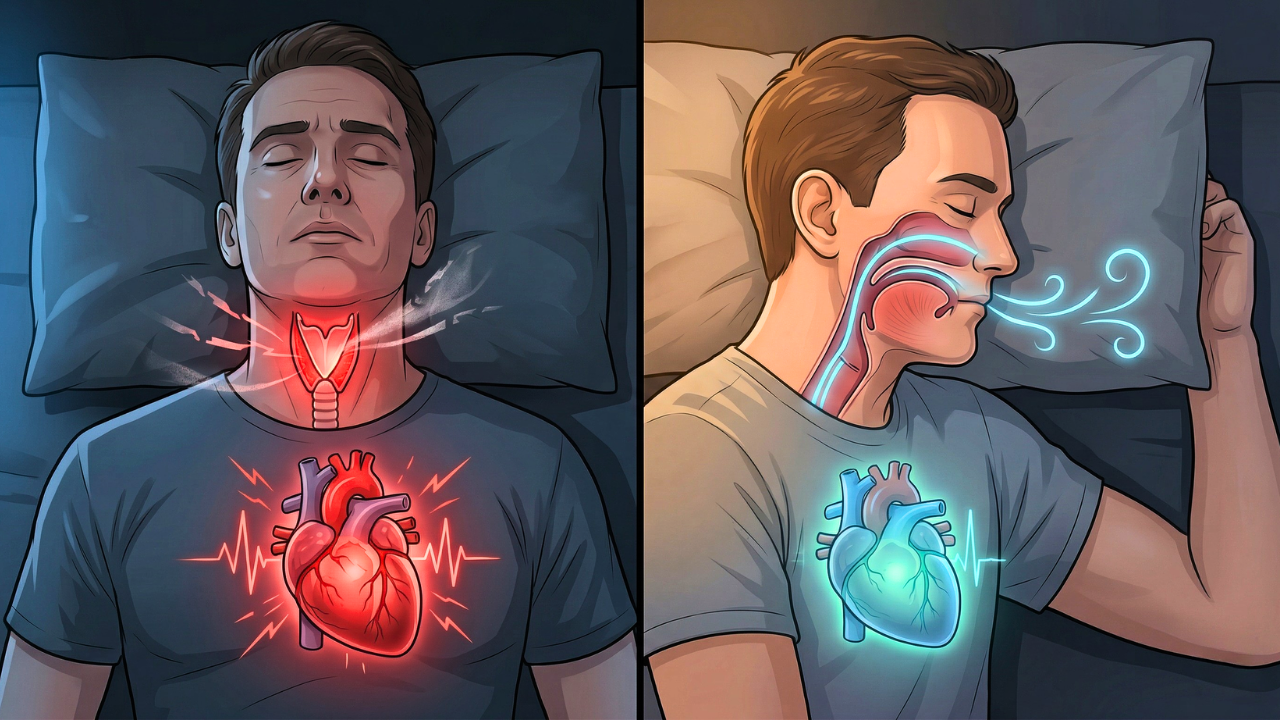

Hello, do you sleep on your back, side, or stomach? Before you answer, I want you to think about something. What if I told you that the position you choose tonight, the one that feels comfortable, could push your heart to the brink of a heart attack, drown your brain cells in its own waste, and literally steal four years of your life?
Because sleep isn’t just about closing your eyes, passing out, and waking up the next day. Sleep is the most important period for the maintenance of the human body. It’s when the brain literally washes its neurons. It is when the heart is at rest. It’s when the hormones adjust. It’s when you rebuild yourself. And if you’re doing it wrong, it’s like taking your car to the mechanic every night, and instead of fixing it, the mechanic takes a sledgehammer and smashes the engine. Will this work? Stay with me, because I’m going to prove to you, with the latest science, what the best sleeping position is, and what the absolute worst. (Based on the vision of Dr. Andre Wampert)
Key takeaways
- Your sleeping position is important: Side sleeping is ideal for brain health, while sleeping on your back can be dangerous, especially if you suffer from sleep apnea.
- Darkness is non-negotiable: Even minimal exposure to light during sleep can increase the risk of a silent heart attack by a staggering 50%.
- Consistency is king: An irregular sleep schedule, even on weekends, is more harmful to your heart than consistent sleep deprivation.
- “Golden Combo”: Simple, small changes — such as an extra 11 minutes of sleep, a 4.5-minute brisk walk, and eating 50 grams of vegetables a day — can reduce your risk of heart attack and stroke by 57%.
- Good sleep starts in the morning: Exposing yourself to morning sunlight for 10 minutes is the most powerful way to reset your internal clock for an optimal night’s sleep.
1. The Goldilocks Dilemma: Finding the Right Sleeping Position
Dr. Rachel Salas, a renowned sleep researcher at Johns Hopkins University, has a fascinating comparison. Choosing a sleeping position, she says, is like a Goldilocks story: “This bed is too hard. This bed is too soft. Ah, but this bed just fits right.” However, this choice directly affects how your brain removes its own neural waste. Yes, your brain has a plumbing system called the glymphatic system. During deep sleep, your brain cells actually shrink by up to 60%, allowing spinal fluid to flow through them and wash away toxins that have built up during the day. It’s like a dishwasher for your brain.
Here’s the important detail: This cleansing flow is enhanced when you sleep on your side — on both sides. If you sleep on your side, you get a point. Why? Researchers have discovered that gravity and spinal alignment help drain this toxic waste from your head. You wake up mentally cleaner. If you sleep in the wrong position, it’s like trying to wash dirty clothes in dirty water. It won’t get clean.
2. The worst situation ever for millions
Sleeping on your back, the supine position, is the worst possible position for anyone with sleep apnea. If you like sleeping on your back, you need to change. There is a shocking 34% of middle-aged men and 17% of middle-aged women Sleep apneaThe vast majority have no idea. When you lie on your back, gravity pulls your tongue and the soft tissue in your throat back, blocking your airway.
Besides snoring and annoying your partner, your body goes into a state of complete despair, struggling to get oxygen. Your carbon dioxide levels rise, an irregular heartbeat develops in your heart, your blood pressure rises, and your risk of stroke and silent heart attack increases. It’s a mini cardiovascular stress test that happens dozens of times every night. Imagine that. Your heart is tormented in your sleep by a mistake you didn’t even know you were making. Well, now you know.
3. When the side you choose matters
In medicine, details are everything. There are specific situations where the side you sleep on changes absolutely everything.
- For heart failure: Patients with a weak heart instinctively avoid sleeping on their left side. Why? Because lying on the left side leads to pressure on the heart on the lung, causing shortness of breath. It also puts extra stress on the valves. The body, being intelligent, prefers the right side.
- For acid reflux (GERD): Here the opposite is true. People with reflux They benefit greatly from sleeping on their left side. The stomach is anatomically located below the esophagus, and gravity helps keep the acid in its correct place. If you turn to your right side, the acid can move up, and that terrible burning sensation will wake you up in the middle of the night.
- For pregnant women: For them, the left side is pure gold. The largest vein in our body, the inferior vena cava, runs along the right side of the spine. If a pregnant woman lies on her back, the weight of the uterus puts pressure on this vein, reducing blood flow to the heart. The result is dizziness, shortness of breath, and decreased flow of oxygenated blood to the baby.
4. Tennis ball trick: A simple trick for better sleep
You might say, “But Dr. Andre, I go to sleep on my side and wake up on my back snoring. What should I do?” Here’s a trick mentioned in real science articles: Sew a pocket on the back of your pajama shirt and stick a tennis ball in it. If you roll onto your back during the night, the ball will be uncomfortable, and it will instinctively roll to your side without waking you up. Is it uncomfortable? Yes. Does it work? definitely.
5. The silent danger lurking in your bedroom
If you think sleep apnea is scary, pay attention. Exposure to light at night increases the risk of a heart attack by 50%. This is not because people are sleeping less; That’s because light itself — even if it’s the faint glow of a TV standby light, a phone charger, or a streetlight peeking through a crack in your curtains — passes directly through your closed eyelids to a nucleus in your brain and destroys your circadian rhythm.
Your master clock, which controls your hormones, thinks it’s daytime and lowers melatonin production. This leaves your body in a state of low-grade alert and persistent inflammation throughout the night. It’s like keeping the flame of stress lit when you’re supposed to be resting. A study of nearly 90,000 people who used smart watches found that those who slept in rooms with more light had a 47% higher risk of cardiovascular disease. Your body’s peak sensitivity to light is between midnight and 6 a.m., which is exactly the time when your heart should be at absolute rest. the solution? Dark cave room. Blackout curtains, no TV, no glowing phone, no charger LEDs. Complete darkness. If you must have a light, make it red or amber, never blue or white.
6. The hidden danger of lying down on the weekend
This is for night shift workers, frequent travelers, and most of us really. We all know about jet lag, but most people suffer from it Social jet lag. If you go to bed at midnight from Monday to Friday and wake up at 7 a.m., but on Saturday you go to bed at 3 a.m. and wake up at noon, your risk of heart attacks and strokes increases by 26%. And here’s the kicker: This happens even if you get the recommended seven hours of sleep. You might be asleep enoughBut irregularity destroys your heart faster than sleep deprivation. Your body loves routine. It’s biology. Your body wasn’t designed for a volatile schedule; It was made for predictability.
7. The sleep duration paradox: Is more always better?
Let’s bust the myth of the mandatory 8 hours. Studies show that the sweet point is between 7 and 8 hours. Seven hours is the bliss point for most people. Some people are comfortable with a 6.5, others need a full 8. The real test is: Can you work and think clearly without drinking coffee until 10 a.m.? If yes, then you are getting enough sleep. If you wake up needing gallons of coffee, something is wrong.
Chronic insomnia ages the brain by four years. If you’re 50, your brain works like a 54-year-old. This damage occurs faster if you carry the APOE4 gene, the main genetic risk factor for Alzheimer’s disease. Lack of sleep plus the APOE4 gene is a devastating combination. But here’s a fact that will surprise you: sleeping for a very short period of time (less than 6 hours) increases the risk of death by 14%. But sleeping too much (more than 9 hours) increases the risk of death by 34%. Wait, so sleeping too much is more deadly than sleeping too little? The truth is that sleeping too much doesn’t do that a reason illness; It’s a sign that your body is trying to repair damage that already exists. Depression, chronic inflammation, obesity, hypothyroidism, or even sleep apnea you didn’t know you had. Long sleep is a symptom, not the killer. If you sleep 10 to 11 hours and still wake up exhausted, it means your body is screaming that something is seriously wrong. See a doctor.
8. Beyond Early Birds and Night Sleepers: What’s Your Sleep Type?
Science has gone beyond just two types of sleep. Researchers mapped the brains of nearly 30,000 people and discovered that we are divided into five genetic subtypes. Which one are you?
- Early Bird 1 (idealistic but anxious): He wakes up very early, is healthier, but feels very anxious. They can’t turn it off.
- Early Bird 2 (Depression): He also wakes up early but has no energy. The body is awake but the mind is not. It is associated with symptoms of depression.
- Owl 1 (Chaotic Genius): They sleep into the wee hours, have the highest IQ and best cognitive performance, but their emotional regulation is terrible. Creative but impulsive.
- Owl 2 (sedentary): He sleeps too late, puts him at risk for cardiovascular disease, has a poor diet, and is inactive. This is the group that worries researchers the most.
- Owl 3 (the “sick” alpha male): Men with high testosterone who believe that little sleep is a sign of strength. Spoiler: Their blood vessels are very different. They have a high risk of developing high blood pressure, baldness, and prostate problems.
9. The “Golden Kit”: A simple formula to reduce your health risks
In conclusion, a recent study of more than 50,000 people revealed what researchers called the “golden cocktail” – a simple combination of changes that reduced the risk of heart attacks and strokes by a staggering 57%.
- Pillar 1: Just 11 extra minutes of sleep every night. Less than one press of the snooze button.
- The second pillar: walk briskly for only 4.5 minutes daily. This is not a marathon. He walks quickly from the car to the office.
- Pillar 3: Eat only 50 grams of vegetables in your diet. Less than a carrot or a handful of broccoli.
10. The ultimate secret to a good night’s sleep
The secret to a good night’s sleep doesn’t start at night; It starts in the morning. Your brain is programmed to receive sunlight, which has a strength of 10,000 lux. If you wake up and go straight into an office with 400 lux dim lighting, your brain will get confused. When you wake up, open the window. Get 10 minutes of sun on your face, preferably before 10 a.m. This instantly resets your internal clock and tells it, “The day has started. Set up your melatonin 15 hours from now.” Your brain needs this contrast: lots of light in the morning, and very little light at night.
The 10-point checklist for transformative sleep
- period: 7-8 hours per night. The test is to wake up well without coffee.
- position: Side sleeping. Use the tennis ball trick if you roll onto your back.
- Bedroom: Dark cave. Black out curtains, no LED lights.
- routine: Maintain a regular schedule, even on weekends.
- Morning light: Open the curtains as soon as you wake up to perform a biological reset.
- Screens: No screens one hour before bed. Use a blue light filter if necessary.
- sunlight: Get 10-15 minutes of morning sun without sunglasses.
- The 20-minute rule: Can’t sleep? I wake up. Go into another room and read in dim, warm light until you feel sleepy.
- Caffeine: Avoid it after 2 pm.
- Diet: Add 50 grams of vegetables or two pistachios at night.
conclusion
Do you see how sound sleep does not require miracles? An extra 11 minutes, good food, a brisk walk, morning sun, a regular schedule – small changes with huge results. Don’t underestimate your comfort. Those who sleep well live longer, have sharper memories, stronger hearts, less inflammation, and a lower risk of dementia. Sleep is the best preventive medicine out there, and it’s 100% free. And the best part? If you start now with just three or four of these changes, you’ll wake up in a couple of weeks feeling different. You will have more energy, a clearer mind, and more joy. Your transformation begins tonight.
source: Dr. Andre &

