
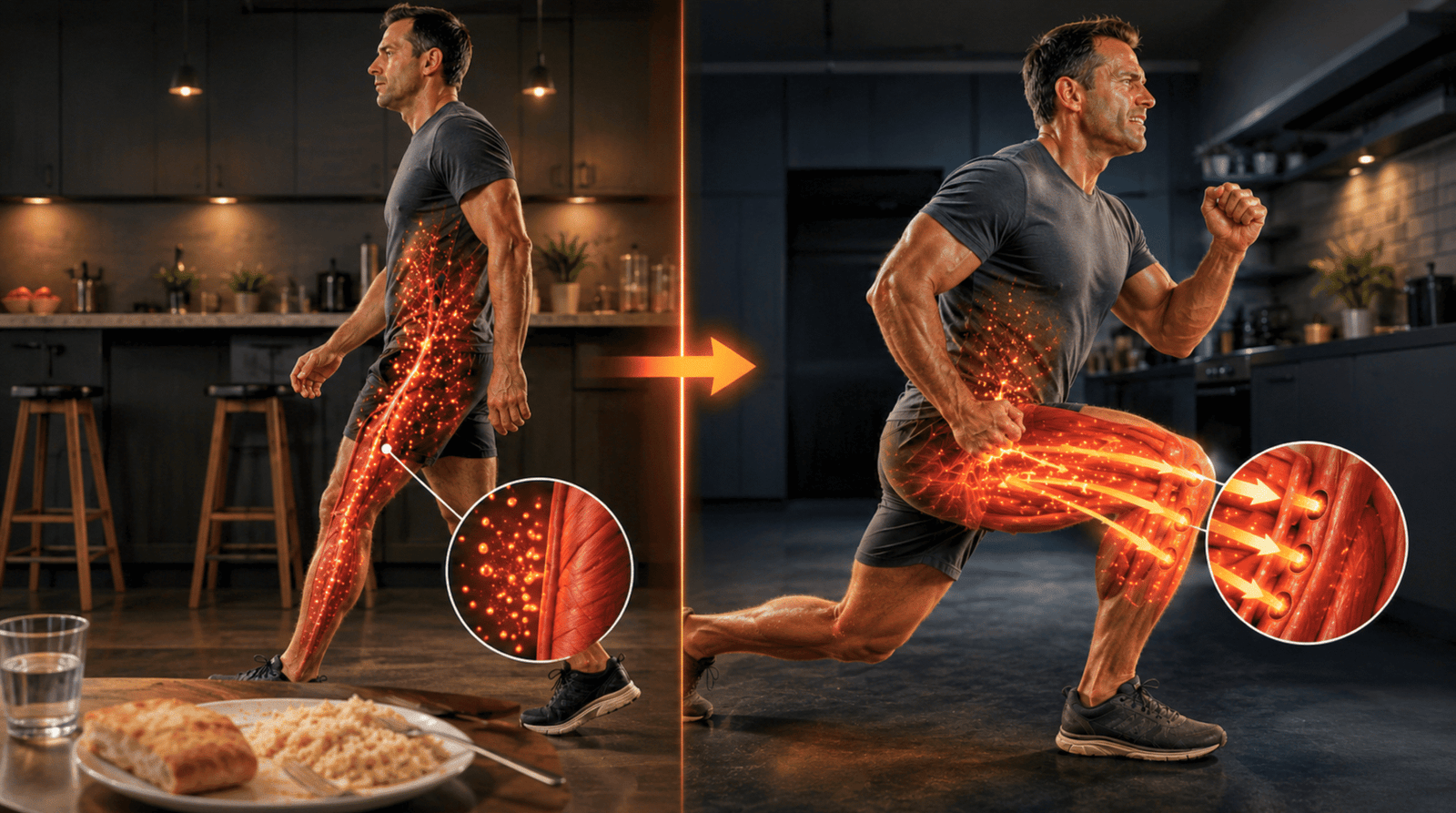


Have you ever been told that walking after eating carbs is a great way to manage your blood sugar? It’s not bad advice, but what if I told you there was a bodyweight trick—that only takes 60 seconds—that could boost your ability to handle carbs, shift your body into fat-burning mode, and put you firmly in the driver’s seat of your metabolism?
Today, you are about to learn:
- Push-ups or squats are more effective than walking after meals.
- How mineral water (yes, you read that right!) can make insulin work smarter.
- The ideal time to eat carbohydrates so that they go directly to your muscles instead of being stored as fat.
Let’s break down the science, tricks, and simple things you can do today to push glucose into your muscles on demand. (Based on the insights of Thomas Delawer)
Key takeaways
- Short, intense body-weight exercises after meals can help you control your blood sugar more efficiently than walking.
- Drinking mineral water high in calcium supports better insulin release, which helps your body deal with carbohydrates.
- Consuming carbohydrates during intense or extended workouts helps ensure they are used for energy and muscle repair, and not stored as fat.
1. Why is walking after eating carbohydrates not enough?
We’ve all heard that walking after a carbohydrate-rich meal helps lower blood sugar. While this does transport some glucose to your muscles, it’s only a light touch. Think of it like a garden hose on a smoldering fire – it helps, but you need something a little stronger if you want faster, deeper results.
2. Force intense muscle contractions: squats and push-ups
Here’s where it gets interesting: Your muscles have a metabolic “back door.” When you do intense exercises like bodyweight squats or push-ups, you quickly use up a molecule called ATP (direct fuel for your muscles). This process turns on a master switch called AMPK, which acts as a fuel gauge in your body. When AMPK is activated, it screams for more energy, telling muscle cells to open their GLUT4 “doors.”
Here’s the golden solution: When you only do two or three sets of bodyweight exercises to near failure right after eating, you’re forcing your muscles to absorb glucose directly, with a little help from insulin. This moves glucose out of your bloodstream and into your muscles, where it is burned for energy, rather than stored as fat. Walking? It’s good, but it doesn’t activate this effect nearly as powerfully.
3. How to do the post-meal exercise trick
Once you’ve finished your meal, don’t just sit down. Instead, do two or three sets of:
- Push-ups (even if you can only do a few, that’s ideal – just work to the point of failure)
- Bodyweight squats or air squats
- Stabs
Your goal? Exposure to mild burns to your legs, chest, or back. This short burst activates AMPK and turns your muscles into blood sugar sponges for 15 to 60 minutes.
4. Make your insulin work smarter with mineral water
The next big breakthrough: minerals, especially mineral water. Let’s focus on calcium, something you may not realize is important Insulin effectiveness.
After eating carbohydrates, the pancreas secretes insulin to help cells absorb glucose. Calcium acts like a spark plug in this process, triggering the release of actual insulin from the pancreas. Without getting enough calcium through your diet (not supplements!), this process can be slow. This means your body has to work harder, and you risk not having effective blood sugar control.
Easy solution? Sip high-calcium mineral water such as San Pellegrino, Gerolsteiner, or Evian throughout the day. Check the bottle for calcium content. You can also eat fermented dairy products like kefir, Greek yogurt, or cheese (low-sugar, of course); Just avoid packing too many calcium supplements (which can mess with your magnesium balance).
5. Strategic carb timing: Eat carbs to build muscle, not fat
Believe it or not, there is an ideal time to eat carbs and not worry about gaining fat: during intense or long workouts. Here’s why:
When you exercise hard — like lifting weights or doing serious cardio — your muscles contract repeatedly, flipping the AMPK switch and opening the GLUT4 floodgates. The carbohydrates you consume during this window are absorbed directly into your muscles, providing immediate energy and replenishing your glycogen stores. They essentially bypass the normal fat storage pathway.
Try sipping a simple carbohydrate like watermelon juice or even adding fast-absorbing cyclic dextrin to your workout water during sessions longer than an hour. This strategy helps your muscles use carbohydrates efficiently and keeps insulin levels in check.
6. Don’t let your cells “forget” how to use carbohydrates
If you regularly restrict your carbohydrate intake or your cells suffer from insulin, Your mitochondriaYour cells’ engines can become lazy to use glucose. By incorporating carbohydrates into muscle contractions during exercise, you can train your body to use glucose efficiently again. This means that over time, your body becomes better at breaking down carbohydrates for energy and recovery, not fat.
7. Putting it all together: Your new game plan
Here’s your simple 3-step routine for better carb control and blood sugar management:
- Immediately after eating your meals: Do 2-3 sets of squats, push-ups or lunges. Bring each set close to failure for best results.
- Throughout the day or before meals: Sip high-calcium mineral water or eat a small serving of kefir or Greek yogurt (watch the sugar!) to keep the “spark plug” burning for insulin release.
- During intense or long workouts: Add fast-acting carbohydrates to your water — try cyclodextrin, watermelon juice, or another source — to increase glucose absorption without storing fat.
conclusion
You don’t have to feel out of control every time you enjoy some carbs. Using these simple, science-backed tricks—short bouts of body-weight exercise, mineral-rich foods and water, and strategic carbohydrate timing—you can train your body to handle carbs efficiently, avoid fat gain, and keep your energy steady. Try these tips today, and notice how much better you feel after every meal!
source: Thomas DeLauer

