


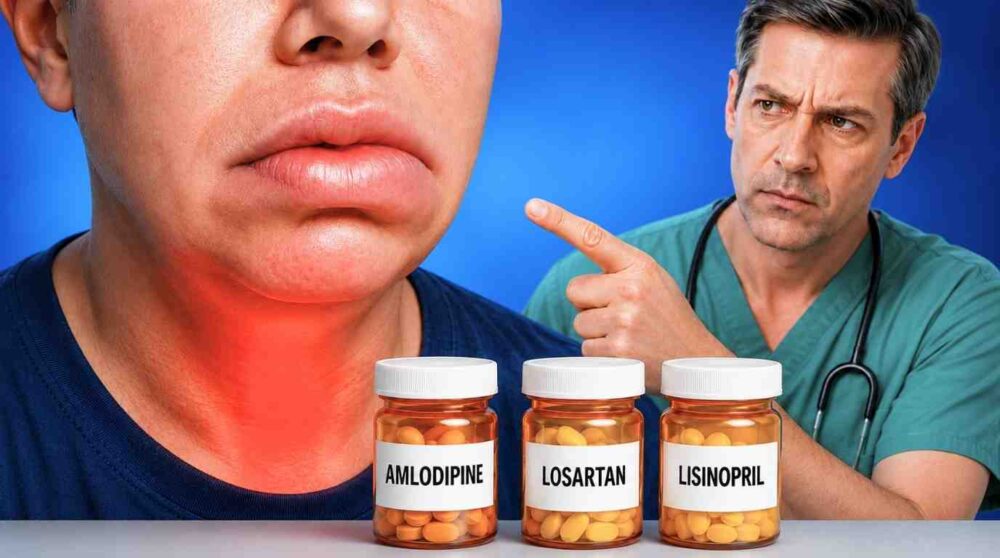
If you’re over 60 and taking amlodipine, losartan, or lisinopril, there’s a good chance something is going on inside your body that your typical 12-minute doctor’s appointment doesn’t have time to fully explain. Here are nine things worth understanding about the three commonly prescribed blood pressure medications. (Based on opinions of Dr. Eric Bennett)
Key takeaways
- Amlodipine-induced ankle swelling is a predictable mechanical effect, not a sign of heart failure – report it, but do not miss doses above it.
- A dry cough caused by lisinopril can appear months after you start taking the medication, and is often confused with allergies or reflux.
- Swelling of the lips, tongue, face, or throat when taking ACE inhibitors is a medical emergency (angioedema) and needs immediate care.
- “Heart-healthy” potassium-based salt substitutes can dangerously raise potassium levels when combined with losartan or lisinopril.
- Regular use of ibuprofen or naproxen alongside these medicines (particularly with diuretics) can cause kidney stress – consult your pharmacist.
- Illness causing vomiting, diarrhea or loss of fluids can change how these medicines work – contact your doctor before your next dose if you are unable to keep down fluids.
1. These three medications work through completely different systems
Amlodipine, losartan, and lisinopril all lower blood pressure, but through different mechanisms — meaning different side effects and different warning signs. Understanding what is important is to correctly read what your body is telling you.
Amlodipine (calcium channel blocker): The walls of blood vessels are surrounded by smooth muscle that contracts when calcium flows into muscle cells. Amlodipine It reduces the amount of calcium taken in, so the muscles are unable to squeeze as hard – lowering stress by managing the system’s output, not the underlying cause.
Lisinopril (angiotensin-converting enzyme inhibitor): The body produces angiotensin II, a substance that tightens blood vessels and directs the kidneys to retain fluid, using an enzyme called ACE. Lisinopril It blocks this enzyme, essentially stopping the production of the stress signal. Because it also reduces the workload of the kidneys, it is often chosen for patients treating blood pressure and early kidney concerns.
Losartan (ARB – Angiotensin Receptor Blocker): It works on the same system as lisinopril, but at a different point: it allows the production of angiotensin II, but blocks the receptor it needs to tighten blood vessels. The main practical difference is that lisinopril can cause a dry, persistent cough in a significant number of patients Losartan Generally this does not happen, which is why doctors sometimes switch patients between the two.
2. Ankle swelling caused by amlodipine does not mean your heart is failing
Amlodipine works to relax the small arteries in your legs more effectively than it relaxes the small veins – the blood flows easily down but has difficulty flowing back up, so the fluid moves into the surrounding tissue. This is why shoes can fit well in the morning and feel tight by the evening, with the swelling disappearing again by the next morning. This is a predictable mechanical consequence of the drug, and is not a sign of heart failure or kidney damage. Tell your doctor instead of skipping doses out of anxiety or embarrassment. Skipping doses to hide swelling is much more dangerous than the swelling itself.
3. Lisinopril cough can appear months later
If you take lisinopril, be aware of a dry, itchy cough that doesn’t seem to go away. It doesn’t always start right away, sometimes it shows up months after you start taking the medication, at which point people often stop associating it with the medication and blame allergies, reflux, or dry air instead. Dry cough caused by lisinopril is uncomfortable but not dangerous – report it to your doctor, who may switch you to another medication such as losartan.
4. One warning sign with ACE inhibitors that can’t wait: angioedema
Swelling of the lips, tongue, face, or throat — especially if breathing or swallowing becomes difficult — is a medical emergency. ACE inhibitors such as lisinopril can, in rare cases, cause a reaction called angioedema, which can become life-threatening within minutes. Dry cough should be reported at your next opportunity; Swelling of the throat, tongue, or face means seeking emergency care immediately.
5. Pay attention to your kitchen: the hidden danger of potassium
Both losartan and lisinopril can raise potassium levels in the blood, affecting the heart’s electrical rhythm. Symptoms don’t always announce themselves clearly — muscle weakness, the occasional cramp, a skipped heartbeat, or sometimes nothing noticeable until it becomes serious. Salt substitutes labeled “heart-healthy,” electrolyte powders, and senior meal replacement drinks often replace sodium with potassium chloride, quietly adding potassium to the body that’s already holding on to its medications. Read the labels on any “heart-healthy” product in your kitchen, and ask your doctor directly if a potassium-based salt substitute is safe in light of your specific medications.
6. Also check your bathroom cabinet: NSAIDs and kidney risks
If you take lisinopril or losartan — especially along with a diuretic (“water pill”) — regular use of ibuprofen or naproxen can reduce blood flow to your kidneys and increase your risk of kidney injury. Not that any of these things are dangerous on their own; Together, in a slightly dehydrated body, they create conditions that the kidneys struggle to cope with. Ask your pharmacist directly: “Is it safe for me to use ibuprofen regularly given all the medications I take?”
7. What happens to your medications when you get sick
If illness results in vomiting, diarrhea, heavy sweating, or an inability to retain fluids, the same dose of losartan or lisinopril that worked yesterday could behave very differently today — potentially causing dramatically low blood pressure and stress on the kidneys. The medication has not changed. The body within which it operates. A good rule to keep in mind: If you can’t keep fluids down, call your doctor before taking your next dose of blood pressure pills.
8. One reading is the noise – the pattern is the information
Blood pressure is constantly moving with sleep, stress, caffeine, posture, and even the anxiety of having it checked. One reading is not a judgment on whether a medication is working or not. To get a more accurate picture, measure at the same time every day, using the same arm, after a five-minute rest, and look at the overall pattern rather than reacting to any one number.
9. Medication manages the outcomes, and does not eliminate the underlying cause
None of these three medications erases the condition that causes high blood pressure in the first place. Amlodipine reduces the extent of constriction of the arterial walls but does not eliminate the underlying stiffness. Lisinopril blocks the stenosis signal but does not correct the vascular changes causing it. Losartan blocks the entry point of the signal, but the signal is still sent. All three manage the system’s outputs rather than the system itself—which is why follow-up appointments are important, why lifestyle isn’t optional, and why a good number on paper doesn’t mean the conversation is over.
Putting it together: A practical framework
If you are taking amlodipine: Watch for ankle swelling that worsens by evening, dizziness on standing, or facial flushing – report it, and never miss any doses to make it go away.
If you are taking lisinopril: Watch for a dry, persistent cough, even if it starts months later. Any swelling of the lips, tongue or throat is considered an emergency – seek care immediately.
If you are taking losartan: Read every “heart-healthy” label in your kitchen, watch for muscle weakness, cramping, or irregular heartbeat, and ask when your potassium was last checked.
For all three: Never use Ibuprofen Or naproxen regularly without telling your doctor. Call before the next dose if illness has caused a large amount of fluid loss. Measure blood pressure continuously, not interactively. Never stop taking any of these medications suddenly without talking to your doctor first.
Frequently asked questions
Is ankle swelling from amlodipine dangerous?
In general, no. It is an expected mechanical effect of the drug that relaxes the arteries of the leg more than the veins. Report this to your doctor, but do not miss doses to hide it, because skipping doses is more dangerous than the swelling itself.
What should I do if I get a cough after starting to use lisinopril?
Tell your doctor, even if your cough starts months after starting the medication. It’s uncomfortable but not dangerous, and your doctor may switch you to a different medication such as losartan, which does not usually cause this side effect.
Are salt substitutes that contain potassium safe with these medications?
Not necessarily. Losartan and lisinopril can actually raise potassium levels, and adding a salt substitute that contains potassium can cause potassium levels to become dangerously high. Consult your doctor before using one.
What should I do if I get sick and can’t keep down food or water?
Contact your doctor before taking the next dose. An illness that causes significant fluid loss can change how these medications affect your blood pressure, sometimes causing it to drop too low.
Quick reference by medication
- ☐ Amlodipine: Report ankle swelling in the evening or dizziness when standing — do not miss doses
- ☐ Lisinopril: Persistent dry cough reported; Seek emergency care for swelling of the lips/tongue/throat
- ☐ Losartan: Ask when potassium was last checked; Avoid potassium salt substitutes without consulting your doctor
- ☐ All three: Check with your pharmacist before regular use of ibuprofen/naproxen
- ☐ All three: Call your doctor before your next dose if illness has caused you to lose a large amount of fluid
- ☐ Measure your blood pressure at the same time, on the same arm, after rest – never stop suddenly without talking to your doctor
source: Dr. Eric Bennett
Disclaimer: This article is for general informational purposes only and is not a substitute for professional medical advice, diagnosis, or treatment. Swelling of the lips, tongue, face, or throat, or difficulty breathing or swallowing, is a medical emergency – seek immediate care. Never stop or adjust your prescribed blood pressure medication without consulting your doctor.

