


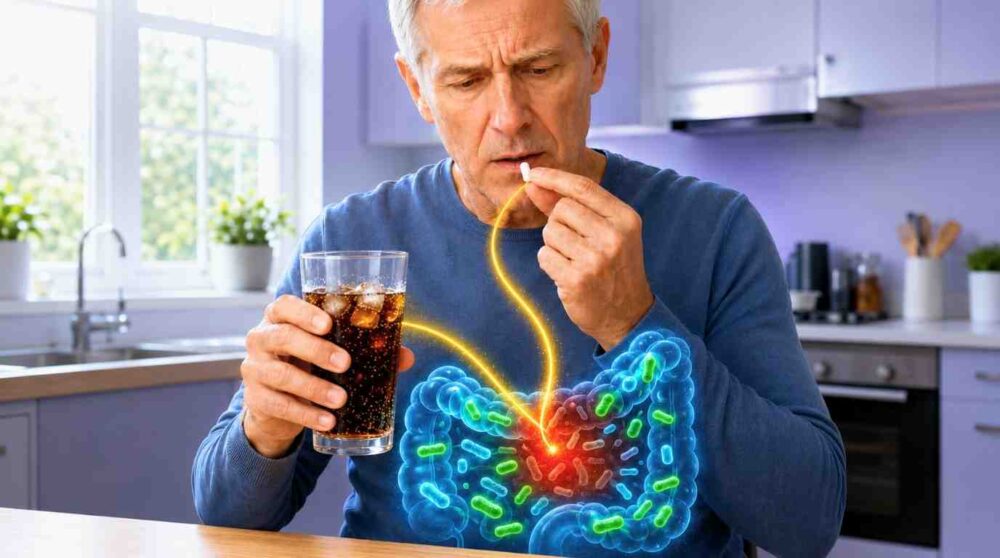
Someone taking antidepressants turns to diet soda without a second thought—sweetener and medication always feel like two completely separate things. New laboratory research conducted in Cambridge suggests that this assumption may not hold up: at least one common sweetener appears to behave very differently once it is mixed with a specific drug.
Researchers at the MRC Toxicology Unit at the University of Cambridge tested 39 commercially used sweeteners against 25 species of gut bacteria, and found that most were not the biologically “invisible” substances they are often marketed as.
Key takeaways
- About three-quarters of the 39 sweeteners tested affected the growth of at least one type of gut bacteria in laboratory experiments – including well-known types such as aspartame derivatives, sucralose and stevia.
- The most dramatic effect came from combining isosteviol, a sweetener derived from stevia, with duloxetine, a widely prescribed antidepressant, which together acutely suppressed two types of beneficial gut bacteria.
- Researchers found more than 100 cases where the sweetener behaved differently when combined with something else, such as caffeine, flavorings or medications.
- This is laboratory research only—conducted in bacterial cultures and cell models, not humans—so it does not yet show that these effects occur within the human body.
What the researchers actually did
The team planted 25 different types of… Gut bacteria Separately in the laboratory, including some considered beneficial, some neutral, and some potentially harmful, each was then exposed to 39 sweeteners to see whether their growth accelerated, slowed, or stopped. About three-quarters of the sweeteners changed the growth of at least one species, evidence that, the researchers say, contradicts the common assumption that sweeteners simply pass through the body without interacting with anything.
Since people rarely consume the sweetener in its entirety, the team then linked the sweeteners to other everyday substances — caffeine, vanilla flavor, and eight commonly used medications. This resulted in more than 100 cases where the combination changed the effect of the sweetener, making it stronger in 34 cases and weaker in 68 cases.
Why did the combination of antidepressants emerge?
The striking result came from pairing isosteviol, a compound derived from stevia, with duloxetine — an antidepressant also used for anxiety and some chronic pain conditions, prescribed to more than 4.2 million people in the United States in 2023. Together, the two compounds powerfully suppressed two types of bacteria, Roseburia intestinalis and Parabacteroides merdae, both of which are considered important for digestive and metabolic health. Professor Kiran Patel, the study’s senior author, told Newsweek that the team expected some interaction between the compounds, but not that strong.
To get closer to how the gut actually works — as a crowded ecosystem rather than as an isolated species — the researchers also built a simplified community of all 25 bacteria together and exposed them to the same groups. The combination of isosteviol and duloxetine reduced the overall microbial diversity of the community, a trait generally associated with a healthier, more resilient gut, and shifted the balance such that some species thrived while others declined. Follow-up tests indicated that the changes also led to increased toxicity toward some host cells and affected the activity of immune-related cells.
What this does not appear yet
It’s worth being precise about what this study can and can’t tell us. Every experiment here was conducted using bacteria and cell models in a laboratory setting, not in the human digestive tract, where sweeteners are absorbed, broken down, and attenuated in ways that a test tube cannot replicate — and where a person’s diet, genetics, and gut bacteria vary greatly. The researchers themselves are clear that this does not prove that sweeteners or this specific combination causes harm to humans, and that human studies are a necessary next step to see if these effects appear in real doses.
What’s next
The researchers say their findings should guide future studies examining whether these interactions actually occur in the human body, at what doses, and whether they produce any measurable health effects. Currently, there are no specific guidelines for avoiding sweeteners or this group of medications – just a reminder that “inactive” ingredients may be more biologically active than usually assumed.
Source: Blasche, S., Periwal, V., et al. (2026). Common xenobiotics modulate gut microbial responses to low-calorie sweeteners in vitro. Molecular systems biology. doi: 10.1038/s44320-026-00225-6.

