


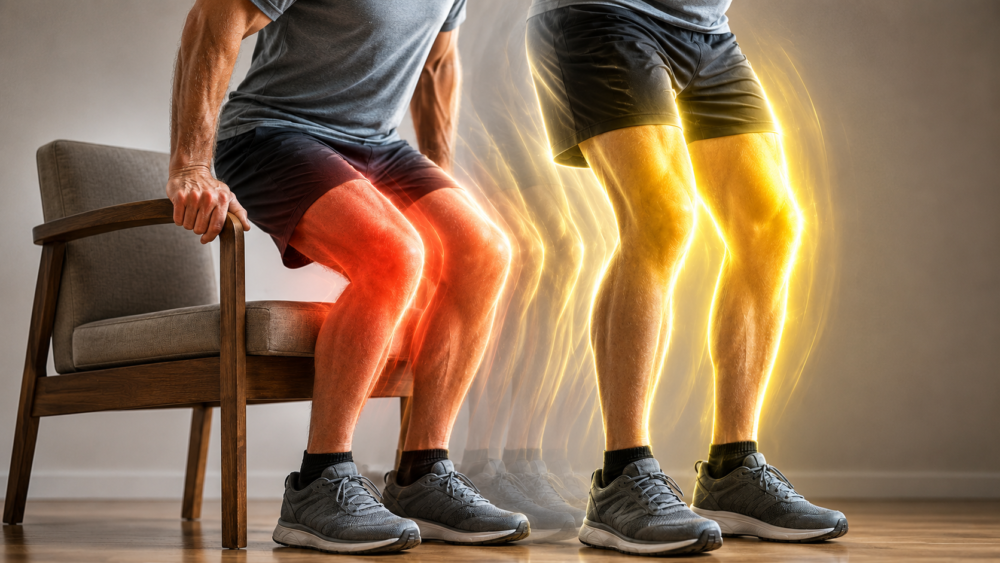
This may seem like an unlikely claim, but a large Danish cohort study published in the British Medical Journal (BMJ), which followed nearly 3,000 men and women for more than a decade, found that people with smaller thighs had a much higher risk of heart disease and premature death — regardless of their overall weight or the amount of fat they carried around their midsection. Here’s what the research actually found, why it matters, and what to do about it.
Key takeaways
- A Danish BMJ study found that a thigh circumference of less than approximately 60 cm is associated with a significantly higher cardiovascular disease and death risk, independent of body fat, smoking and activity level.
- This is not a finding that “bigger is always better” – above the 60cm threshold, there was no additional benefit from larger thighs.
- Thigh size largely reflects muscle mass, which plays a key role in regulating blood sugar and reducing chronic inflammation.
- Functional tests such as the sit-to-height test and the body-weight squat give a rough sense of leg strength without the need for an examination.
- Lower body resistance training two to three times a week can build meaningful strength at any age, including your 70s and 80s.
What the study found
The researchers measured the participants’ thigh circumference and followed them for years, tracking cardiovascular disease and mortality. Once thigh circumference dropped below approximately 60 cm (about 23.6 inches), the risks rose sharply — and this remained true even after accounting for body fat, smoking, blood pressure, cholesterol, and activity level. This is what made the result so remarkable: the association persisted independently of other known risk factors.
Importantly, this is not a case of “bigger is always better.” Above the 60cm threshold, there was no additional benefit from having larger thighs. The risk was concentrated at the lower end – the thighs that were most worn – rather than reflecting a straight-line relationship where more is always better.
Why is a small thigh a warning sign?
The researchers concluded that thigh circumference largely accounted for muscle mass. A small thigh often reflects very little muscle throughout the body as a whole. This is one of the few body measurements where a smaller number is the number in question — almost all other common measurements, such as waist circumference or BMI, work in reverse, with a larger number indicating more risk.
The difference comes down to what is actually measured. It mostly reflects a large waist Visceral fat – Deep, metabolically active fats surrounding organs such as the liver and intestines, which release inflammatory signals linked to heart disease and diabetes. In contrast, a large thigh is made up mostly of muscle along with subcutaneous fat, a different type of fat that research suggests can be metabolically protective and acts as a safer long-term storage site, keeping fatty acids away from the heart and liver.
Muscle or fat? How to tell
A tape measure alone can’t differentiate between a large thigh that’s mostly muscle versus a thigh that’s largely soft tissue with little muscle underneath — and a large but weak thigh probably doesn’t have the same protective benefit. You don’t need to do a scan to get a rough idea of where you stand. It is considered:
- Can you get out of a chair without using your hands?
- Can you get up off the floor without using your hands?
- Can you do 10 bodyweight squats without stumbling or needing support?
- When you tighten your thigh muscles, do they feel tight or soft and flabby?
It’s the strong, muscular thigh that carries the longevity benefit described in the research — not size per se.
The metabolic role of the leg muscle
Your legs and buttocks make up the largest muscle group in your body, and skeletal muscle is where most of the sugar from your diet is stored after a meal, under the influence of insulin. When leg muscles are developed and active, they help filter blood sugar efficiently and maintain low insulin levels. When it shrinks, blood sugar has fewer places to go, which over time contributes to insulin resistance and an increased risk of type 2 diabetes. This is part of the reason why resistance training has been shown in research to improve insulin sensitivity, often in just a few weeks.
Muscles as a signaling device
Research over the past two decades has found that muscles act as an active signaling organ. When muscles contract, they release molecules called myokines into the bloodstream, which travel to fat tissue, the liver, blood vessels, and even the brain, helping to reduce inflammation, support healthy blood vessel function, and even support mood and memory. Since your legs contain a large percentage of your total muscle mass, they are a major source of these protective signals every time you use them.
Why leg strength is important for independence
Leg strength It plays a direct role in fall prevention and recovery – it’s what allows you to catch yourself when you stumble and absorb the impact if you fall. A hip fracture later in life is one of the most serious events an older body can face, with many people never fully returning to their previous level of independence. Research has found that measures such as walking speed and the “sit to rise” test (lowering yourself to the ground and getting back up without using your hands) are strongly associated with longevity, similar to grip strength.
How to build stronger legs at any age
The quadriceps respond to training at any age, and research has shown that people in their 70s, 80s and beyond can build real strength once they start. The most effective approach is lower-body resistance training two to three times a week, focusing on functional movements such as squats, chair sit-ups, step-ups, and lunges (if your knees allow).
The basic principle is progressive overload – gradually asking your muscles to do more work over time, whether through more repetitions, deeper squats, or additional weight. Pair this with adequate protein intake (about 20-40 grams per meal from sources such as eggs, fish, the occasional red meat, lentils or beans) gives your muscles the raw materials they need to rebuild.
If you’re older, less confident, or more frail, starting small — even 5 to 10 chair sit-ups a few times a day — is a solid starting point that you can gradually build from. None of this requires a gym. Your body weight and a sturdy chair are enough to get started.
A note about safety
If you have an existing medical condition or have not exercised in a long time, consult your doctor before starting a new exercise routine, as he or she will know your medical history and any medications that may be related.
Frequently asked questions
Does this mean that bigger thighs are always better?
no. The study found no additional benefit above a threshold of approximately 60cm – the risk was specifically concentrated in significantly smaller thighs, which likely reflects lower muscle mass, rather than a straight linear ‘more is better’ relationship.
What if my thighs are big but not very toned?
A tape measure alone cannot distinguish between muscle and soft tissue. A large, weak, flabby hip probably does not have the same protective benefit as a large, firm, muscular hip, and functional strength appears to be more important.
Is it too late to build leg muscles if you’re older?
No, research has shown that people in their 70s, 80s, and beyond can build real strength once they start resistance training. Starting slowly, such as with a few chair sit-ups, is a reasonable place to start.
Do I need a gym to build leg strength?
No, body weight exercises such as squats, sit-ups, step-ups, and lunges, along with a sturdy chair for support if necessary, are enough to start and build gradually over time.
source: Dr. Alex Webberley
Quick start checklist
- ☐ Try the sit-to-rise test and bodyweight test to measure your current leg strength
- ☐ Aim for lower body resistance training 2-3 times per week
- ☐ Start with squats, sit-ups, standing exercises, stairs, or lunges as your basic movements
- ☐ Apply progressive overload — Gradually add reps, depth, or lighter weight over time
- ☐ Get 20-40 grams of protein at each meal to support muscle repair
- ☐ Consult your doctor first if you have a medical condition or have not exercised recently
Disclaimer: This article is for general informational purposes only and is not a substitute for professional medical advice, diagnosis, or treatment. Consult your doctor before starting a new exercise program, especially if you have an existing medical condition or have not been physically active recently.

