
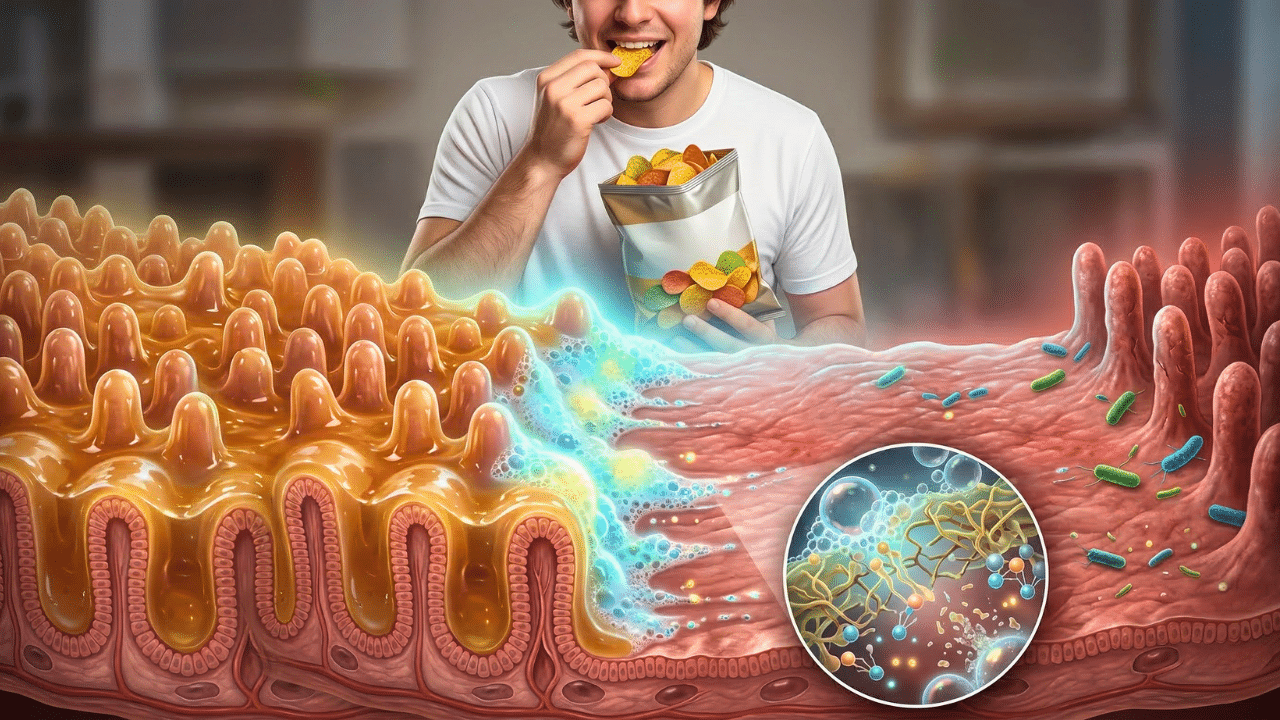


What if I told you that there was a hidden ingredient in most of the packaged foods you eat that worked just like dish soap? Think about what happens when you squirt dish soap on a greased pan. Instantly dissolves and removes grease. Now, imagine that the same chemical process is happening not on the frying pan, but inside the delicate lining of your intestines. There is a chemical that is so common that we consider it natural, and it has the same effect on the protective mucus layer in the intestines. Once this protective lining is compromised, things that should never enter your bloodstream — such as bacteria, toxins, and undigested food particles — begin to leak out. This is the exact definition of leaky gut. The shocking part is that you are probably eating this ingredient every day without even knowing it.
This is not some rare, exotic chemical. It’s hiding in plain sight in about 60% of all packaged foods on grocery store shelves. You’ll find it in ice cream, chocolate, salad dressings, plant-based milks, breads, protein bars, peanut butter, and even baby formula. These ingredients, collectively known as emulsifiers, break down your gut barrier one meal at a time, leading to a cascade of health problems that go far beyond simple bloating. It’s time to pull back the curtain on these food additives and understand what they really do to your body.
Key takeaways
- Emulsifiers work like detergents: Chemicals such as polysorbate 80 and carboxymethyl cellulose are added to processed foods to mix oil and water, but they also dissolve the protective mucus layer in the intestines.
- They cause leaky gut: By loosening the protective gut barrier, emulsifiers allow harmful bacteria and toxins to pass into the bloodstream, triggering an immune response.
- Extensive inflammation: This process leads to chronic low-grade inflammation, which is the root cause of many modern diseases, from irritable bowel syndrome (IBS) to autoimmune diseases.
- Found everywhere: Emulsifiers are found in an estimated 60% of packaged foods, including many items marketed as healthy, such as plant-based milks and protein bars.
- The best solution is to avoid: The most effective way to protect your gut is to eliminate ultra-processed foods from your diet and focus on single-ingredient whole foods.
1. What are emulsifiers (and why are they in your food)?
If you’ve ever tried mixing oil and vinegar to make salad dressing, you know that they naturally separate. Emulsifiers are chemical agents that force them to mix and stay mixed. Food manufacturers use them to improve texture and shelf life Processed foods. It makes ice cream and mayonnaise creamy, prevents salad dressing from separating, and gives bread a smooth, uniform texture. They create a smooth and pleasant “mouth feel” that will keep you coming back for more.
While this sounds useful from a food science perspective, the problem is that these are industrial chemicals, not food. They confuse the names on ingredient labels, e.g Polysorbate 80, Mono- and diglycerides, Carboxymethyl celluloseand Carrageenan. You may see these names and have no idea what they are, but their function is purely cosmetic. It does not add any nutritional value. Their only job is to make the treated product look more attractive and last longer on the shelf. However, the trade-off for this convenience is a direct attack on your body’s most important defense system: your intestinal lining.
2. Your gut’s built-in defense: the protective mucus barrier
To understand the damage, you first have to appreciate the amazing design of your intestines. The inside of your intestines is covered with a thick, tough layer of mucus. This is not like the mucus in your nose; It is a very sophisticated barrier. On one side of this barrier, you have the contents of your gut — food, trillions of bacteria (your microbiome), and many digestive byproducts. On the other hand, just one cell layer away, is your bloodstream and about 70% of your immune system.
This mucous layer acts as a vigilant guard. It is designed to allow carefully digested nutrients to pass into the bloodstream while keeping bacteria, undigested proteins, and toxins safely within the gut. It separates the chaotic world inside your gut from the sterile, controlled environment of your inner body. When this barrier is healthy and thick, your immune system can rest easier. But when it gets hacked, everything explodes.
3. How emulsions work to dissolve your intestinal defenses
This is where the dish soap analogy gets scarily real. The chemical property that makes an emulsifier so good at mixing oil and water in food is what makes it so damaging to your intestines. The protective mucus layer is a complex substance, but it has properties that emulsions are specifically designed to break down. By their nature, they are surfactants, i.e. agents that reduce surface tension.
When you eat foods that contain these chemicals, they don’t just pass through. They act on the lining of your intestines, thinning and dissolving the valuable mucus barrier. It is not an allergic reaction. It is a direct chemical action. You are literally eating detergent that strips your body of its natural protections. With every meal containing processed foods, you can weaken this barrier, making it thinner and less effective. Over years of repeated daily exposure, this vital armor can be almost completely worn away.
4. The domino effect: from leaky gut to chronic disease
Once the mucus barrier is weakened, the single layer of cells lining the intestine (epithelium) becomes exposed. Bacteria that are beneficial members of your microbiome can now migrate through this weakened wall and enter your bloodstream. Your immune system, which is constantly patrolling on the other side, sees these bacteria as foreign invaders, like pathogens. He immediately labels them as villains and launches an attack.
This leads to an immune reaction, also known as inflammation. At first, it may be a low-grade, persistent infection that you don’t notice. You may just feel bloated or a little tired. But if you continue to take these lozenges, you continue to stimulate your immune system. The inflammation gets worse, eventually leading to visible damage and scarring of the interior of the colon. This chronic inflammation is now linked to a wide range of health problems. Your ability to absorb nutrients becomes weak, leading to deficiency. Circumstances like Irritable bowel syndrome (IBS)It is possible to develop Crohn’s disease and ulcerative colitis. Furthermore, this gut-derived inflammation is now understood to be a major driver of many autoimmune diseases, where a disturbed immune system begins to attack the body’s own tissues.
5. What the science says: The troubling evidence
While much of the initial research has been done on animals, the evidence is mounting and deeply concerning. In animal studies, feeding mice common emulsifiers such as polysorbate 80 caused them to develop metabolic syndrome, gain weight, have blood sugar problems, and experience significant negative changes in their gut bacteria. Of course, the food industry is quick to point out that these are animal studies. However, we now have compelling human data.
A controlled human trial published in 2024 gave participants food containing the emulsifier for just two weeks. The results were amazing. In that short period, the participants’ intestinal microbes changed dramatically, and the researchers noticed that the bacteria moved closer to the intestinal lining, which is the first step in the process of… Leaky gut. Think about it: only two weeks. What happens after 20 years? We don’t have 20 years of experience, but we can look at demographic data. In the past two decades, as consumption of ultra-processed foods has increased, rates of irritable bowel syndrome have doubled, and autoimmune diseases have risen dramatically. Although this is not conclusive proof of causation, it is a strong association that we cannot ignore.
6. The simple and powerful solution: Change your environment
So, what can you do? You can spend hours at the grocery store, looking at ingredient labels and trying to memorize the chemical names of emulsifiers. But there is a simpler and more effective solution: stop eating ultra-processed foods. If it comes in a box, bag, or plastic container and has a long list of ingredients you can’t pronounce, don’t buy it.
The most powerful strategy is to change your environment. Don’t keep these foods in your pantry, refrigerator, or desk at work. We all have weak moments when we’re tired, stressed, or hungry. In those moments, willpower is no match for the convenience of grabbing a pre-packaged snack. If it’s in your house, you’ll eventually eat it. I’ll be honest with you, I have a weakness for potato chips. My wife and I agreed not to keep them in the house, because if we did, I would find them and eat them. By removing temptation, you won’t have to battle your willpower every day. If you had to get in your car and go to the store to get fast food, you probably wouldn’t.
Bottom line: Reclaim your health by reclaiming your food
Your health really starts in your gut. The chronic diseases that plague our modern world—from digestive disorders and autoimmune diseases to brain fog and metabolic syndrome—often begin with a breakdown of the intestinal barrier. Emulsifiers are the main culprit, acting as a hidden cleanser that systematically dismantles the body’s defenses. The solution isn’t a new supplement or magic pill; It’s a return to real food. By consciously choosing to fill your plate with whole, unprocessed foods—fruits, vegetables, high-quality meats, and healthy fats—you remove the chemical attack and give your gut the opportunity to heal and repair itself. Take control of your environment, reclaim your kitchen, and you will reclaim your health.
source: Dr. Eric Berg


