
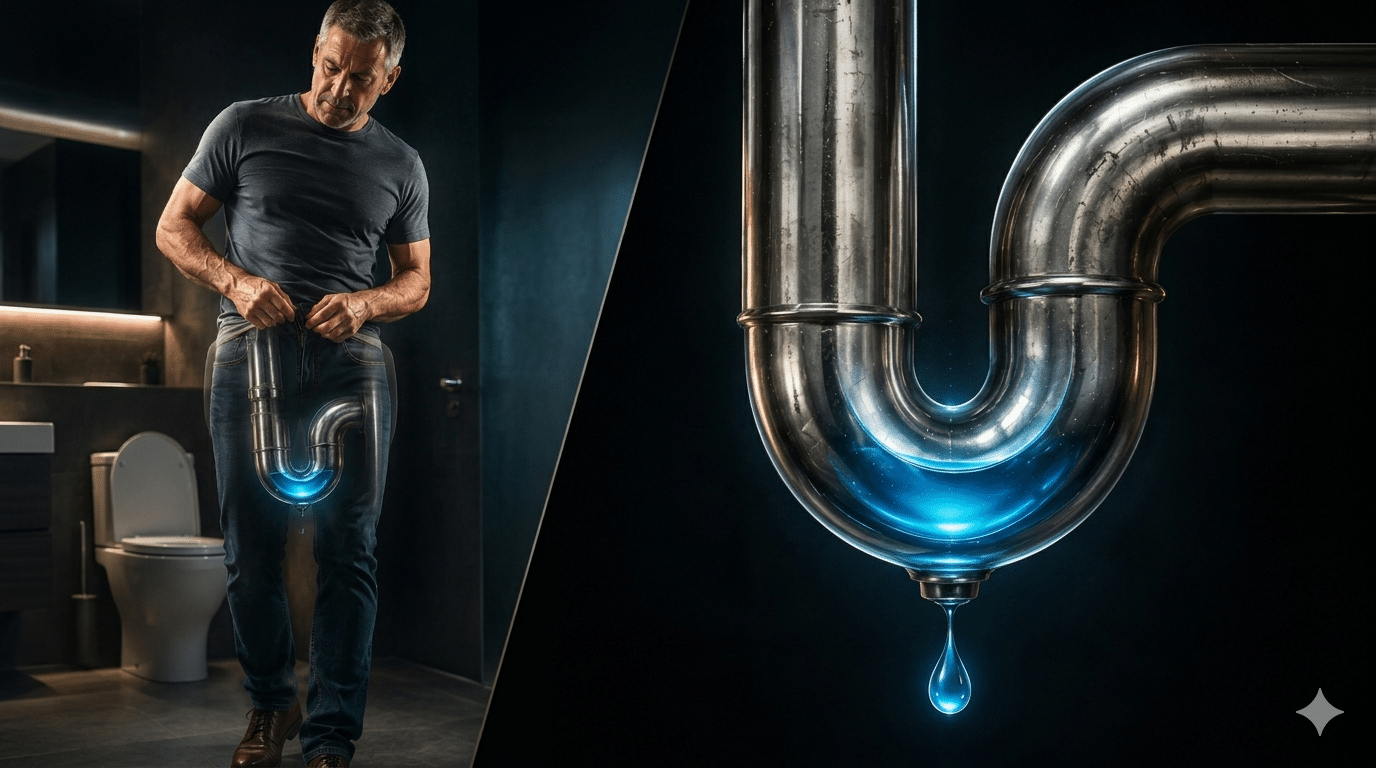


You’ve just finished peeing, zip up your zipper, take a few steps, and then you feel it—that dreaded, embarrassing wet spot. A little urine has come out, and now you feel uncomfortable and anxious. Your mind may immediately jump to serious conclusions. Is it a prostate problem? Is this the beginning of urinary incontinence? For most men, especially those over 50, the answer is no. This common problem, known as post-urinary dribbling, affects up to four in ten men and is usually not a sign of illness.
Most often, the problem is not medical, but mechanical. Think of it as a simple plumbing problem inside your body. In this article, we’ll dive into the real cause of this frustrating drip, explore why it happens, and most importantly, give you practical, effective solutions you can start using today. You’ll learn immediate techniques to prevent leaks and long-term strategies to solve the problem for good. It’s time to stop worrying in silence and take control. (Based on the insights of Dr. Alberto Sanagstín)
Key takeaways
- It’s a plumbing problem: Post-urinary dribbling is usually caused by a small amount of urine trapped in the urethral bend, not by bladder or prostate failure.
- Age factor: As you age, your pelvic floor muscles can weaken, making it difficult to completely empty your urethra after urinating.
- Rushing makes things worse: Rushing or straining while urinating can cause the muscles to tighten, trapping more urine and causing leakage later.
- Hot fixes exist: Simple, gentle techniques performed after urination can help you empty your urethra completely and prevent embarrassing drips.
- Effective long-term solutions: Specific exercises can strengthen the pelvic floor muscles, significantly reducing or even eliminating the problem over time.
- Know the red flags: Although they are usually harmless, it is important to know the signs (such as pain or blood) that mean you should see a doctor.
1. What really causes this drip? (It’s not what you think)
To understand what’s happening, I want you to imagine the drain pipe under your kitchen sink. Did you know that the U-shaped bend in the pipe? It’s called a P-trap, and its job is to hold a little water to prevent sewer gases from going up the drain. Your body has a similar setup. The tube that carries urine from the bladder to the outside of the body, the urethra, has a similar curve. This section, called the bulbar urethra, descends just below the scrotum before heading toward the penis.
When you urinate, your bladder contracts and pushes the urine out. When you feel like you’re done, your bladder has done its job. However, just as a pelvic trap always holds a little water, the U-shaped curve in your urethra can trap a small amount of urine. You press, you move away, and gravity does the rest. The remaining urine flows out, creating that wet spot. So, you see, it doesn’t mean that the bladder is still leaking or that the prostate is failing. It is simply a small residual amount of urine leaking from the pipeline. This is a mechanical problem, not necessarily a disease. In fact, studies show that prostate size and post-urination dribbling don’t always go hand in hand, so it’s a mistake to automatically assume prostate He is the culprit.
2. Why is this happening to me? now?
You’re probably thinking, “But I’ve had this curve in my urethra all my life. Why is it a problem now?” This is an excellent question. Although the “plumbing” has always been there, many things can change with age affecting your body’s ability to fully empty that curve.
First, the pelvic floor muscles, the hammock of muscles that supports the bladder and bowel, can lose strength and tone over time. These muscles play a key role in controlling urination, and when they are weaker, they don’t provide the same support to help push out the last few drops. Second, urethral strength may decrease with age. A less powerful current is less effective in cleaning the entire urethra. Third, you may find it difficult to completely relax the area, which is crucial to emptying it completely. Finally, if you are often in a hurry or feel stressed, your muscles, including your pelvic floor, tend to tense up. This tension can put pressure on the urethra, making urine retention more likely. So, the curve is the same, but your body’s ability to empty it has changed.
3. The two biggest mistakes men make
When many men face this problem, they unintentionally make things worse. The first and most common mistake is to immediately blame the prostate and start worrying. You may spend months in anxious silence, fearing what the doctor might find. This fear prevents you from looking for simple, effective solutions to a problem that can often be easily managed.
The second mistake is rushing. You feel the drip, so you rush back to the bathroom, try to get the last bit out, then quickly zip up again. This actually exacerbates the problem. This urethral curve takes a few seconds to empty. If you move too early, gravity will do its work on your underwear after a few moments. Moreover, rushing creates stress. When you feel anxious and try to finish quickly, your pelvic floor muscles tighten, pressing on your urethra and holding urine more effectively. It’s a vicious circle. By the way, if you drink a lot of coffee, that may be a contributor. Caffeine is known to be a bladder irritant and can aggravate the condition. You don’t have to get rid of it, but it’s good to know that cutting back a little may help.
4. The immediate solution: the two-step technique
So, what can you do now? There are two main solutions: one for today and one for the coming months. Let’s start with the immediate fix. This is a simple technique you can use every time you urinate.
First, when you think you’re done, don’t move. Just wait. Remain relaxed at the urinal or toilet for an additional two or three seconds. Do not push or strain; Just give your body time. You may find that less urine comes out on its own. Leave it.
Second, you can help blank out the curve manually. Place two fingers on the perineum, which is the area behind the scrotum. Gently press upward and forward, tracing the path of the urethra. This is one gentle milking motion, you’re not pressing too hard. The goal is simply to get the last bit of trapped urine out of the U-curve. Also pay attention to your clothing. If your pants are too tight or the zipper is short, it may force you to aim at an inappropriate angle, making urine trapped more likely. At night, try urinating while sitting and leaning slightly forward. This position helps relax the pelvic muscles and uses gravity to your advantage, promoting full-body emptying without any rush or tension.
5. Long-term solution: train your pelvic floor
For a more permanent solution, you need to address the root cause: muscle weakness. Just like any other muscle in your body, your pelvic floor muscles can be strengthened through exercise. These exercises, often called Kegel exercises, can significantly improve or even completely eliminate dribbling after urination. Studies show that about three out of four men who do these exercises consistently see significant improvement.
The exercise itself is simple and can be done anywhere without anyone knowing. First, you need to identify the correct muscles. Next time you urinate, try stopping the flow midway. The muscle you squeeze to do this is the pelvic floor muscle. Important: Do not exercise while urinating. This is just to help you find muscle. Once located, you can perform the exercise “dry” while sitting, standing, or lying down.
Here’s the routine: Squeeze the muscle as if you were trying to stop urinating. Hold the contraction for 5 seconds, then relax completely. This is one repetition. Do a set of 10 reps, three times a day. It’s free, requires no equipment, and is incredibly effective. If you have pelvic pain, a urinary tract infection, or have had recent prostate surgery, it’s best to consult a health care professional or physical therapist to make sure you’re doing it right. But for most men, it is a safe and powerful tool for taking back control.
6. When should you really worry? Red flags for your doctor
While dribbling after urination is usually benign, there are certain cases where you should absolutely consult a doctor. This is not to scare you, but to enable you to know when professional medical advice is necessary.
Please see your doctor if you experience any of the following:
- You see blood in your urine.
- You feel pain or burning when you urinate.
- You have a fever or feel generally unwell with urinary symptoms.
- The dribbling started suddenly and is a new problem for you.
- Dribbling is accompanied by a feeling that the bladder does not empty completely, that the urine stream is too weak, or that you have to strain to urinate.
- It’s not just a drop or two after you urinate; You have leaks throughout the day, have intense urges, or lose bladder control.
These symptoms can indicate other conditions that need to be properly diagnosed and treated. But if you’re experiencing that typical and expected drip a few steps after you’ve finished urinating, you now have a much better understanding of what’s going on.
conclusion
That annoying drip after urination doesn’t have to be a source of silent anxiety or embarrassment. For the vast majority of men, this is not a sign of serious illness, but rather a simple mechanical “plumbing” problem that can be managed and even solved. It’s not always the prostate, and it’s not always urinary incontinence. Sometimes, only a little urine remains in the tubes. By understanding the cause and applying the simple techniques and exercises we’ve discussed, you can take immediate and long-term steps to fix the problem. You are now equipped with the knowledge and tools to confidently manage this common problem.
source: Dr. Alberto Sanagstín

