
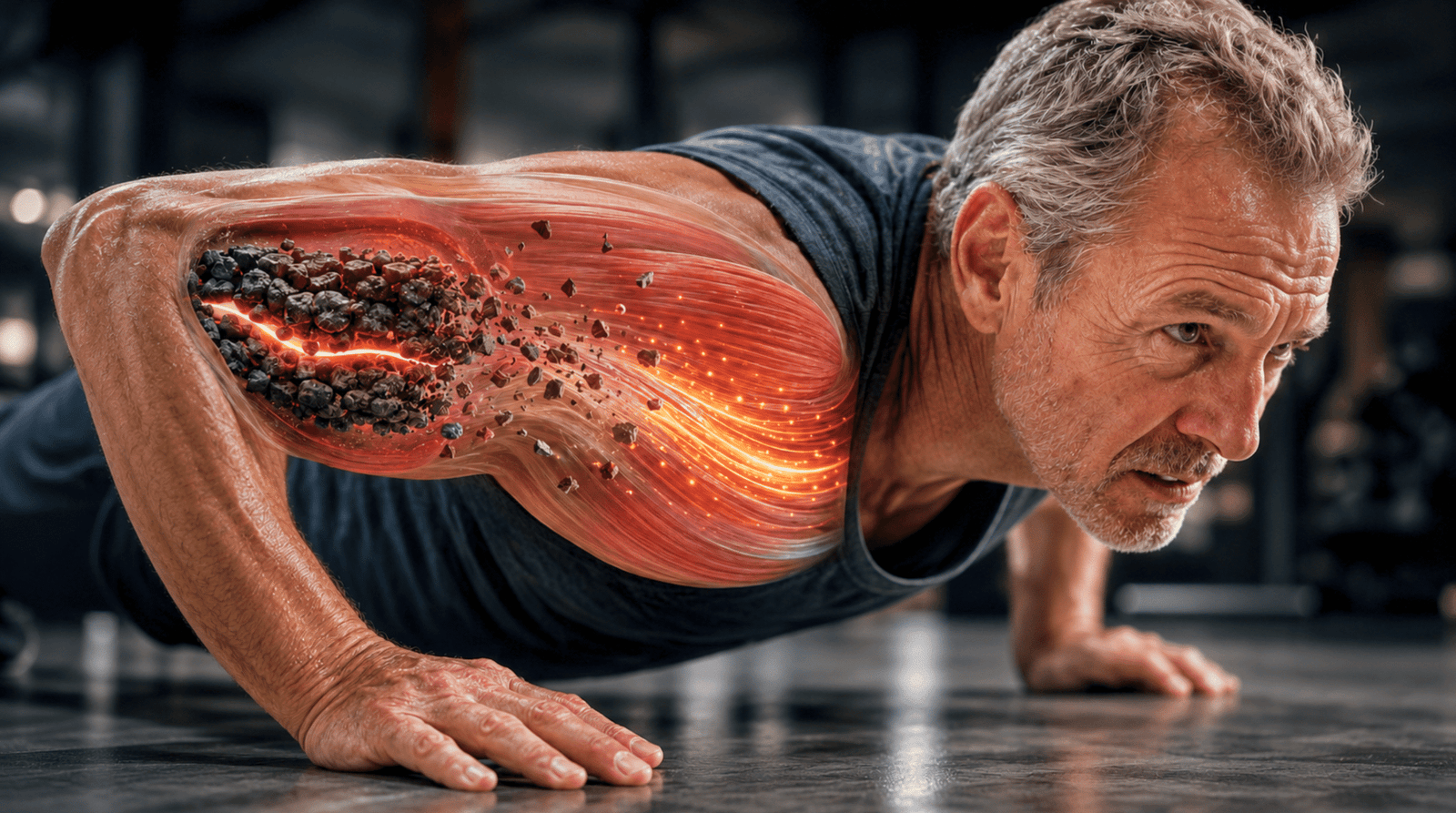


Ready to bend the mind? Let’s challenge the basic assumption that almost everyone has about aging: The older you get, the more muscle you lose. It seems like a simple, inescapable fact of life. And this is not just about appearance. Your muscle mass is directly related to your mobility, metabolic health, and independence. It’s the difference between freedom and friction as you age. The standard advice is always the same: lift weights and eat more protein. But what if I told you that there was a paradox hidden deep within your muscle biology?
You have a signal in your muscles that tells them to build and grow. If your muscles weaken with age, you would naturally expect this signal to fade, right? However, a pioneering new study suggests just the opposite. In aging muscles, the signal is actually to “build and grow.” higher than in younger muscles. So, what’s going on? Why is your muscle tissue still shrinking? As a metabolic scientist, this finding came as a real surprise, until it came to a conclusion. Today, we’ll uncover this fascinating problem together. Not only will I give you a peek into the complex biology of your muscles, but I’ll also give you actionable insights to help you build muscle today and retain it for decades to come. (Based on insights from Nick Norwitz, MD)
Key takeaways
- The muscle aging paradox: Contrary to what you might expect, the primary muscle growth signal (mTOR) is overactive in aging muscles, yet continues to wane.
- The dark side of growth: Chronically high mTOR signaling inhibits the essential recycling and cleaning process of your cells, known as autophagy. This leads to a buildup of cellular “waste” that damages muscle tissue.
- Exercise is a double-edged sword (in a good way): Exercise causes mTOR levels to rise temporarily to build muscle, but exercising regularly Reduces Base level of mTOR, allowing for crucial cleaning and regeneration.
- Muscles are more than just engines: Your muscles are the largest endocrine (hormone-producing) organ in your body, sending signals that affect your heart, brain, and overall health.
- Actionable strategies: In addition to the basics of resistance training and protein, specific compounds such as creatine, sarcosine, omega-3, and oleuropein can provide powerful support for healthy muscle aging.
1. The muscle aging paradox: When “growth” signals go wrong.
To understand this paradox, you first need to know about a protein compound called mTOR. Think of mTOR as the big red “GO” button for growth in your cells. It is crucial for building muscle. So, here’s a simple question: How do you think mTOR activity occurs as you age and lose muscle? If you were using basic logic, you would assume that mTOR activity was decreased. That was my guess too. But this is wrong.
A pivotal study published in Proceedings of the National Academy of Sciences It was revealed that in muscle aging, especially in cases of muscular dystrophy (Age-related muscle wasting), mTOR activity is actually higherAnd no less. Your older muscles are basically hitting the growth button, but they’re getting weaker at the same time. This is the paradox. How can a persistent “growth” signal lead to deflation?
The answer lies in the fact that mTOR has a dark side. While it promotes growth, it also inhibits cell recycling and regeneration pathways, most notably a process called autophagy. Autophagy is your body’s internal cleaning crew; It’s how your cells remove damaged proteins and dysfunctional parts. When mTOR is chronically high, it stops this cleaning process. The result is an accumulation of molecular waste, dysfunctional proteins, and an increase in signs of cellular aging. Simply put, mTOR is a double-edged sword. The growth signal is high, but the quality of your muscle tissue deteriorates because the garbage is never taken out. Over time, the damage from this accumulated waste overcomes the growth signal, and your muscles are wasted.
2. Exercise: The ultimate rejuvenation of your muscles
So, if the problem is constantly having active mTOR, how do we solve it? The answer is beautifully elegant: exercise. Exercise has a wonderfully complex relationship with mTOR. In the short term, immediately after exercise, exercise increases mTOR activity. This is exactly what you want to stimulate muscle protein synthesis and stimulate growth.
But here’s the magic: long-term, actually consistent exercise routine Suppresses Baseline and chronic levels of mTOR hyperactivity. In fact, exercise does two things perfectly. It gives you a sharp signal to grow your muscles, and restores efficient recycling and regeneration processes by allowing autophagy to do its job. You get growth and Cleaning – the best of both worlds. Animal studies bear this out, showing that both endurance and resistance exercise in older people reduce basal mTOR levels, increase autophagy, and reduce signs of cellular aging. In short, exercise rejuvenates your muscles from the inside out at a deep molecular level.
3. More than just a motor: Your muscles are a master hormonal factory
It’s time to stop thinking of muscles as purely mechanical tools for lifting things. An underappreciated fact is that your muscular system is the largest endocrine organ in your body. That’s right, your muscles secrete hormones and other powerful messages, just like your thyroid or adrenal glands.
When your muscles contract, they release these substances, which travel throughout your body and communicate with other organs. This communication between organs – from muscle to heart, from muscle to brain, and from muscle to adipose tissue – is a huge determinant of your overall health. This can affect how well your heart can handle stress, how your brain develops, and even your risk of developing mental health conditions like depression. There are even strong links between lean muscle mass and higher levels of NAD+, a key molecule for energy and cognitive flexibility. The bottom line is that your muscles aren’t just for movement; They are central nodes in a vast signaling network that regulates your health from head to toe.
4. Powerful strategies to support healthy muscle aging
First and foremost, the single most important factor in healthy muscle aging is resistance training. It is absolutely non-negotiable. Trying to use supplements to build muscle without a foundation of resistance training is like throwing gummy vitamins on an ice cream sundae and calling them healthy—it completely misses the point. You know that protein is important too. But let’s dive into some other powerful, high-return strategies you can use.
- Creatine: This is one of the most well-studied supplements on the planet, and it’s not just for bodybuilders. As you age, your muscles need more support, and Creatine Helps meet this demand. A huge amount of data shows that it can increase muscle strength, promote muscle growth (hypertrophy), and even support fat loss. It works by drawing water into muscle cells (growth stimulant), activating muscle stem cells, and increasing the building blocks needed for muscle fibers. The standard and effective dose is 5 grams of creatine monohydrate per day, preferably taken with food.
- Sarcosine: Here’s one you may not have heard of. Sarcosine is an unusual amino acid that has shown promise in combating age-related muscle loss. Studies show that sarcosine levels tend to decline with age, but preclinical trials suggest that supplements can effectively prevent this loss. While the research is still in its early stages, it is a safe compound to consider. The equivalent human dose used in studies is about half a gram per day.
- Omega-3 fatty acids: Long-chain omega-3s (EPA and DHA) are found in Fatty fish Providing a wide range of benefits, including a positive effect on muscles. They help promote muscle health by reducing chronic inflammation, improving the body’s sensitivity to insulin, and directly enhancing muscle protein synthesis. The literature generally supports a goal of 1.5 to 2 grams per day, which you can easily get from eating seafood like salmon and sardines a few times a week.
- Oleuropein: It is a natural compound found in olives and, more concentrated, in olive leaf extract. Oleuropein shows promising ability to improve muscle performance by activating energy production within mitochondria, a process that tends to decline with age. In animal studies, it has been shown to improve muscle performance and increase muscle mass. It is usually taken between 500 and 1000 mg daily.
Bottom line: Your muscles are your foundation
Muscle aging isn’t just about shrinking biceps; It’s a window into the deeper mechanisms of how our bodies age. From the paradox of the hyperactive “growth” signal to the elegant, rejuvenating effects of exercise, we’re learning that muscle health is about much more than just lifting heavy weights. Your muscles are complex signals, in constant conversation with the rest of your body, shaping how you think, how you feel, and how resilient you are in the face of illness.
So what should you do with this knowledge? You must train, move, and nourish your body with intention. If you want to keep your body younger for longer, building and maintaining muscle isn’t optional. It’s foundational. Beyond all the complications, there is one simple truth: the best time to start building better muscle is always the same. now.
source: Nick Norwitz, MD

