
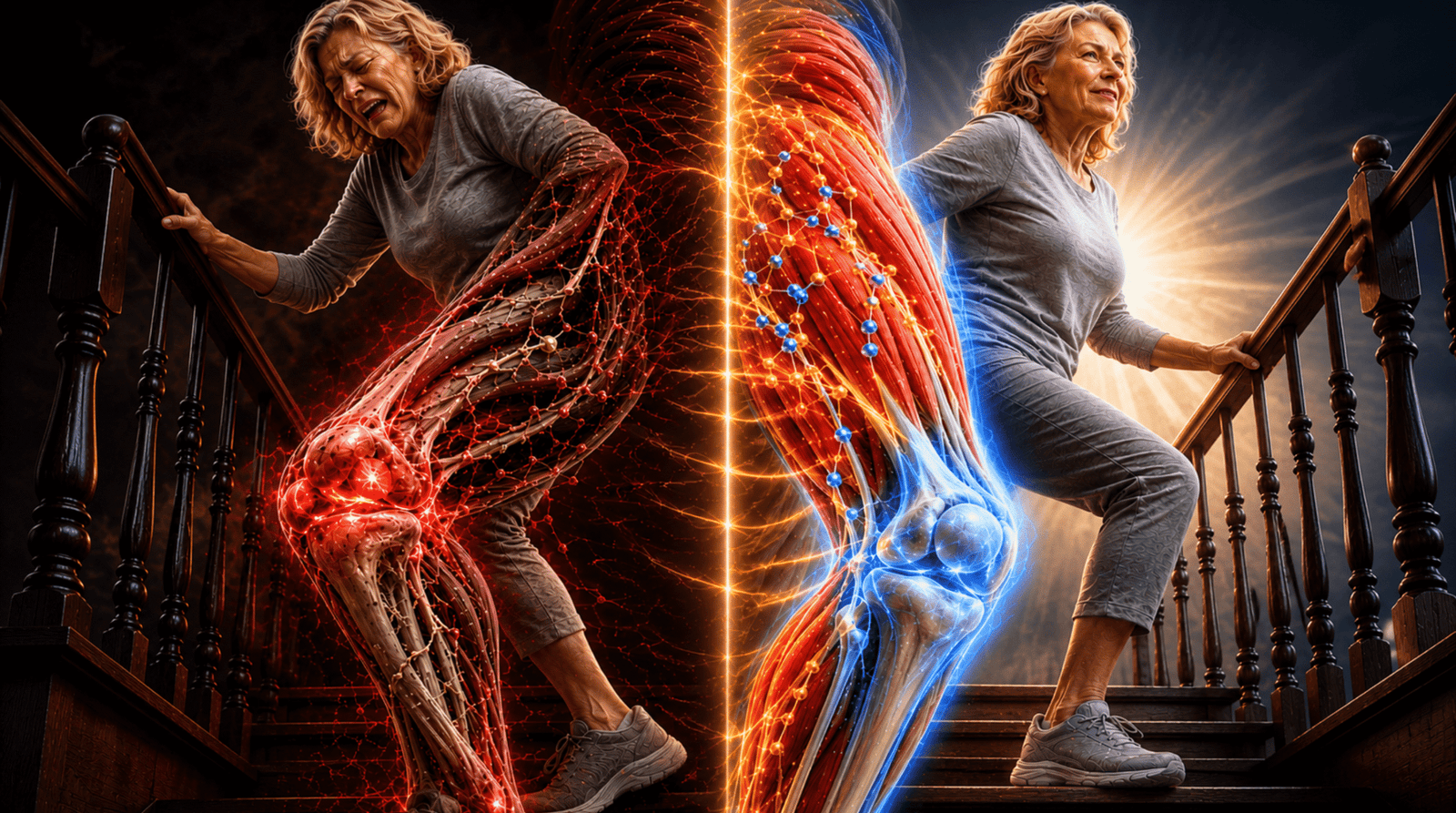


The biggest lie about longevity isn’t about magic pills or secret diets. It’s the belief that getting to 90, 95, or 100 is a victory, no matter how you got there. The uncomfortable question is not how long you will live, but… how You will live. Will you be able to get up from the sofa without using your hands? Can you shower without fear of falling? Will you feel confident walking down the street, or will your children have to reorganize their lives around your care?
The goal is not just to live more years; You should be independent for as long as possible, until the end. Of course, there are the basics: don’t smoke, avoid toxic habits, and watch your diet. But there’s one specific, silent mistake that does more to destroy independence after age 60 than almost anything else. It has nothing to do with expensive supplements, measuring ketones, or chasing the latest longevity fad. It’s the quiet process in which you stop demanding force from your body, day after day, until your muscles begin to act as if you no longer need them. The lie is to believe that your body will hold up on its own. It won’t happen. (Based on the insights of Dr. Alberto Sanagstín)
Key takeaways
- Anabolic resistance: After a certain age, your muscles become less responsive to signals from protein telling them to repair and grow. This is the main reason behind age-related muscle loss.
- Power is the signal: The most powerful way to combat anabolic resistance is through strength training. This sends a clear message to your muscles: “I still need you.”
- Protein is essential: Don’t fall for the myth that protein is bad for your kidneys (unless you have advanced kidney disease). Your muscles need protein as building blocks to stay strong.
- Drug awareness: Certain chronic medications can sometimes contribute to muscle weakness. It is important to talk to your doctor if you notice changes, but never stop taking medication on your own.
- Test yourself: Simple 5-minute tests can reveal whether you’re actually losing the battle for independence, giving you the information you need to take action today.
1. The Real Thief of Your Strength: Understanding Anabolic Resistance
Why do you lose strength even when you eat the same way you always eat? The real culprit is a medical term called “anabolic resistance.” Let me explain it clearly. As the years pass, your muscles become worse at responding to the signals that once told them to repair, build, and stay strong. Imagine that your muscles are a brick wall. To keep this wall strong, you have a team of builders working around the clock. These builders use the protein you eat as new bricks. However, after a certain age, especially if you are not active, these Freemasons become hard of hearing. The protein arrives, the bricks are there, but the command to get down to business is not clearly heard. That’s why, after the age of 60, it’s not enough to just eat the way you used to. Your muscles need a louder and clearer signal.
This process is insidious because it happens before you even notice it. You won’t wake up one day suddenly weak. Instead, you find it a little difficult to open the jar. You may need to push the arms of the chair to stand. I choose the elevator over the stairs more often. Each one of these things is a small surrender, a quiet confirmation to your body that it doesn’t need to be as strong as it once was. Your body is incredibly efficient. If you don’t use your muscles, your body sees them as expensive, high-maintenance tissue and starts breaking them down. This is a start atrophy, Age-related loss of muscle mass and function, which is a direct path to losing your independence.
2. How to “wake up” your muscles: the power of a simple signal
So, what is the strongest signal to put these “deaf builders” back to work? It is mechanical stimulation. In simple terms: strength training. Now, I’m not talking about lifting massive weights or spending hours in the high-intensity gym. I’m talking about giving your muscles a clear message: “I still need you.” You can do this in ways that adapt to your current situation. You can press against the wall. You can use an elastic resistance band. You can do the steps on one staircase while holding on to the support. Performing simple strength training exercises just two or three times a week will do more to wake up your muscles than any supplement on the market.
This is the essential conversation you should have with your body. Every time you challenge your muscles, you send out a biological shout that counters the whisper of anabolic resistance. This stimulation tells your muscle cells to become more sensitive to protein again, to take those bricks and strengthen the wall. It’s not about becoming a bodybuilder; It’s about maintaining the physical ability to live your life on your own terms. It’s about having the strength to catch yourself if you stumble, carry your groceries, and play with your grandchildren on the floor.
3. Could your medications be part of the problem?
There is another layer to this that is often not discussed. Sometimes, it’s not just that your construction workers have difficulty hearing; There are external factors that make it more difficult to repair the wall. I am referring to some chronic medications. I want to be very specific here: I’m not saying these medications are bad, and I’m certainly not telling you to stop taking them. Many of these medications save lives, prevent heart attacks, and control serious diseases. It’s vital. However, in some People, they can affect muscle strength or exercise endurance.
For example, corticosteroids, when used long-term in high doses, can promote Muscle lossespecially in the thighs and arms. Statins, which are incredibly beneficial when prescribed correctly, can be associated with muscle weakness in some individuals. Beta blockers, used to treat heart disease or high blood pressure, can prevent the heart rate from rising during exertion, which some people experience as fatigue or decreased endurance. Again, this is crucial, Do not stop taking any medication on your own. This can be very dangerous. What I’m saying is the opposite: If your strength suddenly decreases, or you’re in pain all over, or if you haven’t felt like yourself since changing your medication, don’t write it off as “getting old.” Talk to your doctor. Sometimes there is room to adjust the dose, change the timing, or find an alternative. The goal is not to choose between medication and muscle; It’s making sure your treatment protects you without taking away your independence too much.
4. The protein myth: Can you eat more without harming your kidneys?
Imagine that your construction workers are finally awake and ready to work, but you haven’t provided them with any bricks. They can’t build anything. This brick is a protein, and this is where the common and dangerous fear comes into play. You may hear someone say, “Eat more protein so you don’t lose muscle,” while another warns, “Too much protein will destroy your kidneys!” You’re left trapped, not knowing what to do. Low protein means muscle loss, but more protein raises fear Kidney damage.
Let’s clarify something important. If you are already seeing a nephrologist for an existing kidney problem and have been given specific instructions regarding protein, you should follow that. The following is for those who do not have medically defined dietary restrictions. For older people without advanced kidney disease, the protein story is more nuanced than it seems. For years, the overarching advice has been “less protein is better.” While this makes sense in late-stage uncontrolled kidney disease, recent studies in older people with normal or even slightly reduced kidney function tell a different story.
Restricting protein too much can lead to greater fragility, accelerated muscle loss, and, in some cases, poorer overall survival. Why? Because even though you may not end up on dialysis, you are very likely to fall, break a hip, or lose your independence due to muscle atrophy. It’s not about ignoring the kidneys. It’s about not letting the fear of hurting them lead to you giving up on your muscles. You need bricks. You need protein from sources such as eggs, fish, chicken, legumes, Greek yogurt and cheese. The goal is not a bodybuilder’s physique; It’s giving your body enough raw materials so it doesn’t have to break down its walls just to keep working.
5. 5-Minute Independence Check: 3 Simple Tests You Can Take Today
How do you know now if the anabolic resistance has already taken effect? You don’t need fancy equipment or a gym membership. All you need is five minutes and a willingness to be honest with yourself. Try these three tests.
- Chair test: Sit on a firm, firm chair without armrests. Cross your arms over your chest. Can you stand and sit five times in a row safely and without using your hands for support? If you can’t, don’t blame yourself. This is not a final ruling. It’s a message from your body’s foundation — your leg muscles and torso — that it’s asking for help.
- Breathing test: Next time you go out, walk a little faster than your usual pace or go up a gentle incline. Do you run out of breath immediately? Does it take you a long time to recover? This is a sign that your “engine” – the cardiorespiratory system – needs more training, checking, or both.
- Panel test: Look at your main meal of the day. Was there a clear primary source of protein on the plate? I’m talking about a serving of eggs, fish, chicken, legumes, or Greek yogurt. Or were your meals mostly based on bread, coffee, biscuits, and other quick items? Your plate reveals whether you are providing your body with the bricks it needs.
If you have difficulty with any of these tests, please do not consider them a failure. It’s just information. Information is not to blame; It’s for work. However, if your loss of strength is accompanied by unintended weight loss, recent shortness of breath, severe pain, fever, or frequent falls, you need prompt medical evaluation. But if what you’re seeing is a slow, silent, gradual decline, you can start turning the tide today.
Conclusion: Your future self depends on you
Within ten years, one person will get in and out of the bathroom on their own, and another will need help. One person will jump off the couch without a second thought, and another will wait for their child or caregiver to arrive. What you do this week doesn’t decide everything, but it decides more than you think.
You don’t have to change everything at once. For the next three days, just try this: Find a stable chair and do five slow, controlled squats. If this is too much, stand on the table and do heel lifts ten times. In your main meal, make sure there is a clear source of protein on your plate. Consider this your first deposit into your future independence account. Get started today. Do it for yourself, but also do it for the people you love.
source:Dr. Alberto Sanagstín

