
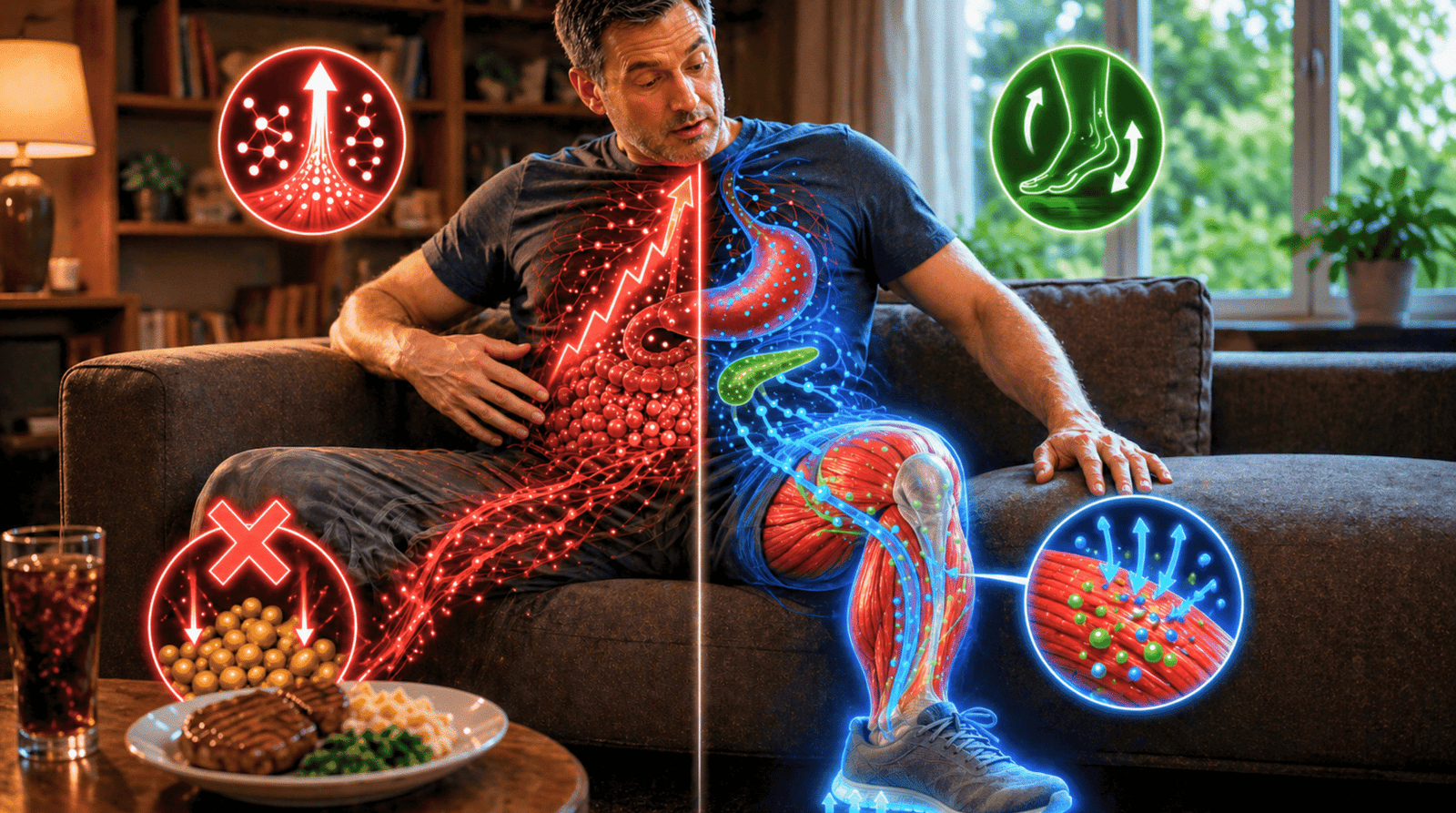


You will love this. Did you know that most people, after finishing a meal, do the worst thing ever to their bodies? They sit completely still. Maybe you’re on the couch watching TV, at your desk finishing work, or relaxing in a chair. Although it’s natural to rest after eating, this period of inactivity is exactly when your blood sugar rises, your body secretes insulin to control it, and your overall circulation begins to slow. Over time, this simple, repetitive habit can contribute to serious health problems such as high A1C levels, increased insulin resistance, and significant stress on the pancreas.
But here’s the amazing news: You don’t need to get up and do a full workout to combat this. You don’t have to expend a lot of energy to help your body process that meal more efficiently. There’s a very simple method you can use where you sit — on the couch, at the office, or anywhere else — that helps your body remove sugar from your blood and keeps your circulation going. It all comes down to a powerful concept: small, fast, continuous movements. Instead of big, strenuous repetitions, you’ll have short, oscillating contractions in your muscles. To your body, it feels like a gentle vibration. It requires very little effort and minimal energy, but provides consistent, useful movement. (Based on Dr. Mandel’s insights)
Key takeaways
- Inactivity after a meal is harmful: Sitting still after eating raises blood sugar, slows blood circulation, and can lead to insulin resistance over time.
- The solution is movement: Small, quick, continuous movements (or “pulse exercises”) can be done while seated to combat the negative effects of inactivity.
- Main health benefits: These simple exercises help lower blood sugar, improve circulation, stimulate the lymphatic system, and increase insulin sensitivity.
- Effortless and accessible: The movements require very little energy, can be done anywhere, and are suitable for people of any age or fitness level.
Gentle pulsing power
When you make these small, pulsating movements, your muscle fibers remain active, even at a very low level. This subtle and sustained activity leads to a series of positive effects within your body. Firstly, significantly Increases blood flowwhich helps move blood from your lower extremities — where circulation often slows when you’re sedentary — to your heart and brain. This is critical for overall cardiovascular health.
Secondly, it stimulates the lymphatic system. Unlike the circulatory system, which has the heart as a powerful pump, the lymphatic system does not have its own pump. It depends entirely on body movement and muscle contractions to move lymphatic fluid and remove waste. When you are static, this system becomes stagnant. These gentle oscillations are exactly what you need to get moving.
Most importantly, especially after a meal, these repeated contractions help your muscles pull glucose directly from your bloodstream. They activate special pathways called GLUT4 transporters, which act like gates on the surface of muscle cells. The movement signals that these gates open and allow sugar to enter the muscles, where it can be used for energy instead of remaining high in the blood, which may signal your body to store more fat. Over time, this practice improves insulin sensitivity and reduces the high demand on the pancreas. Are you ready to try? Here are four simple pulse exercises you can start doing today.
1. Heel beats of your second heart

This first exercise is incredibly effective and targets an important part of your circulation. We’ll start by focusing on your calves, specifically your soleus muscle, which is often called your body’s “second heart” for its role in pumping blood out of your legs.
How to do it: Sit comfortably in your chair with your feet on the floor. Keeping the balls of your feet and toes on the floor, then lift your heels slightly. From this position, begin making small, quick pulsing movements with your heels, moving them up and down. The key here is not a big dramatic move; You are aiming for short, quick contractions. Your heel should never touch the ground during the exercise. It should feel like a nervous leg jiggling, but controlled. Keep the movement continuous and oscillating.
Why it works: If you place your hands on your legs while doing this, you will feel that gentle vibration. This constant movement is what helps pump deoxygenated blood back through the veins, counteracting the effects of gravity and inactivity. By keeping your soleus muscle active, you directly support your heart and improve circulation throughout your body. Meanwhile, these active leg muscles pull up glucose from your last meal, which helps Stabilize blood sugar levels Now, you sit down.
2. Legumes to absorb sugar

Next, we’ll activate the largest muscle group in your body: your glutes. Because these muscles are so large, they have a tremendous ability to act like a sponge Absorption of excess blood sugar. This exercise is very subtle, and you can do it without anyone noticing.
How to do it: While sitting, shift your position slightly so that only your heels are on the floor, with your feet up. To really feel the muscle activation at first, you can even sit on your hands. Now, simply move your heels lightly back and forth, or gently press them into the floor in a pulsating rhythm. You should feel your glutes contracting with each small movement. It’s like a gentle rocking motion driven by your butt. You can do this while watching TV, during a meeting, or anytime you sit down.
Why it works: There is almost no energy required to do this, it feels more like a nervous jolt than exercise. But this simple oscillation is powerfully effective. By engaging the gluteus maximus, you fire up a huge metabolic engine. These large muscles require glucose for energy, and by activating them, you are signaling them to pull this sugar from the bloodstream via the GLUT4 pathways, naturally and without requiring a large insulin response. It is a simple and very effective way to manage post-meal glucose levels.
3. Hamstring pulses for posterior strength

Now let’s target your hamstrings, the powerful muscles at the back of your thighs. Many people have weak or inactive hamstrings from sitting all day, and this simple pulse can help wake them up while providing the same blood sugar benefits.
How to do it: Place your feet flat on the floor in front of you. The focus here is on your heels. Without lifting your feet, try to gently pull your heels toward your chair, as if you were trying to drag them across the floor, but only move them a small fraction of an inch back and forth. Make the movement small and continuous. It’s a very short and catchy movement.
Why it works: To make sure you’re doing it correctly, place your hands under your thighs. You should feel your hamstrings contracting and shortening with each little pulse. This contraction is what does the work. Just like your glutes and calves, active hamstrings will begin pulling sugar from the blood to fuel their movement. Not only does this help lower your blood sugar, but it also improves circulation throughout the back of your leg and strengthens the mind-muscle and posterior chain connection, which is vital for overall stability and strength.
4. Internal and external thigh pulses

Our last exercise is probably the easiest of all, and it works the inner and outer thighs (adductors and abductors) at the same time. This creates a continuous vibration across your entire upper leg, increasing circulation and metabolism benefits.
How to do it: Let your legs relax into a natural sitting position. You can place your hands on your lap or anywhere comfortable. Now, simply let your knees fall in and out, rocking your legs back and forth from your hips. It is a loose, easy, continuous movement. Don’t force it; Just let them swing.
Why it works: This movement creates an internal vibration that you can feel throughout your legs. Place your hands on your legs, quads, or inner thighs, and you’ll feel the gentle activity. When your body is completely still, everything slows down: blood circulation becomes sluggish, lymph flow stagnates, and sugar stays high in your bloodstream longer. But when you continue with these small, quick movements, your muscles stay active, your blood keeps flowing, and your body becomes incredibly more efficient at handling the food you just ate. Think of your muscles like a sponge. When they move, they absorb. When they are still, everything just sits.
Conclusion: Continuity is key
The most important lesson here is that you don’t need to be tough; You need continuity. After eating, you don’t have to get up and run a marathon. In fact, you don’t even have to get up at all. By simply keeping your body in motion in these small, subtle ways, you allow your body to work for you instead of against you. You are effectively lowering blood sugar, promoting circulation, and helping the lymphatic system do its job.
Incorporate these four pulse exercises into your daily routine, especially in the hour or two after eating. Do it for a few minutes at a time, whenever you think about it. It’s a win-win situation that requires almost no effort but yields amazing results for your health in the long run. I promise your body will thank you.
source: Dr. Mandel

