
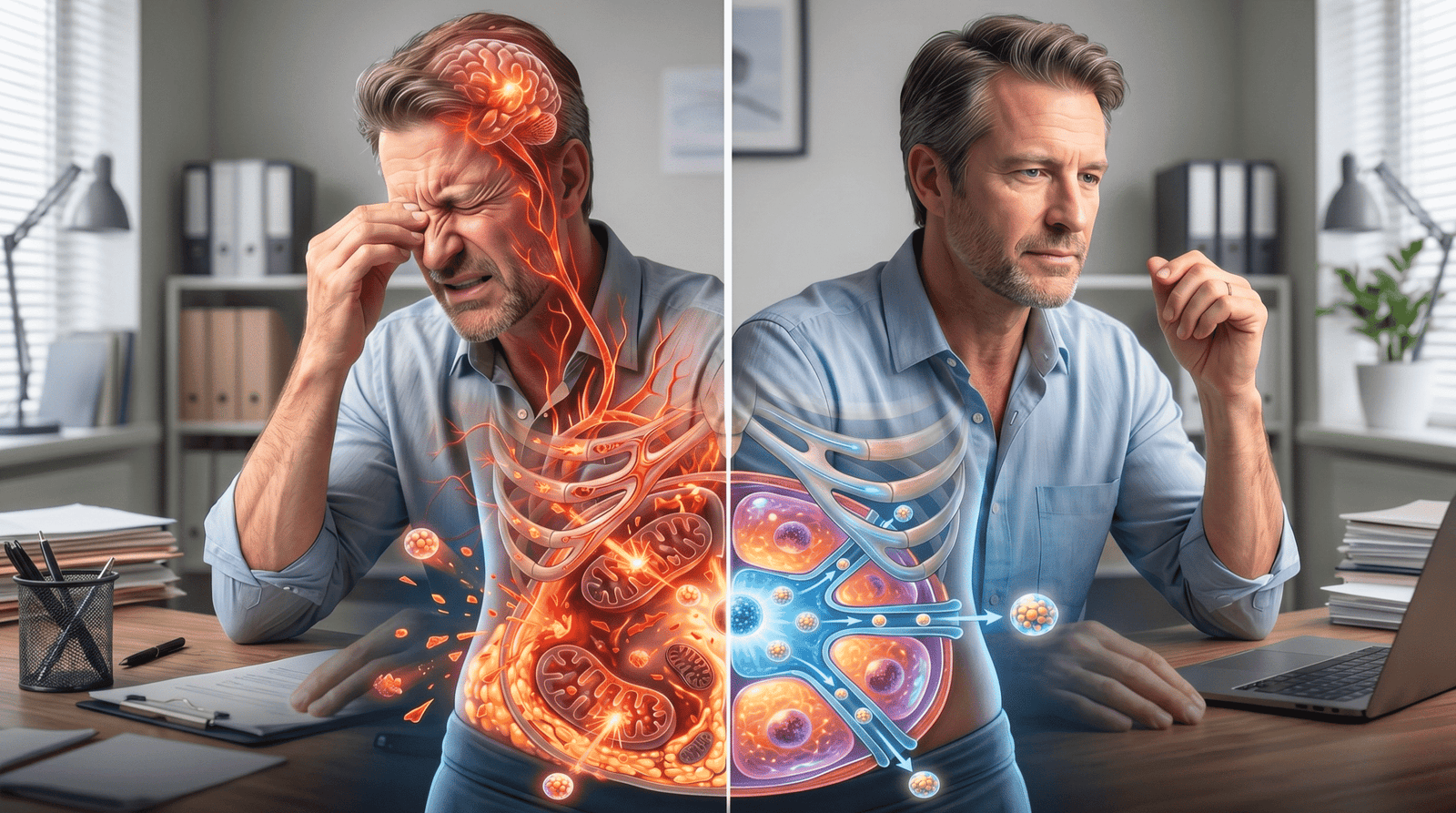


Have you ever looked at two people the same age and wondered why one looks vibrant and full of life while the other looks decades older? Research published in the past decade has confirmed something that fundamentally changes the way we should think about aging: Your chronological age — the number of years you’ve been alive — tells you very little about the actual state of your cells, hormones, and metabolism.
There is a gap between your age and your biological age, and this gap is largely determined by three processes that begin to accelerate after age 40. In clinical practice, you see this spectrum every day. You see the smart, independent 70-year-old who comes in with a simple problem and goes home, and then you see the 58-year-old who seems to have the functional capacity of someone 20 years older. Understanding what separates these two is the most important thing you can do for your long-term health. These processes are why it’s so difficult to recover from illness or injury, why energy levels drop, and why the same life events you used to bounce back from now leave a lasting mark. Today, we’ll find out exactly what these processes are and, more importantly, what you can do to slow them down. (Based on opinions of Dr. Alex Webberley)
Key takeaways
- Biological age vs chronological age: The number of years you have lived does not reflect the true cellular health of your body. Lifestyle choices can significantly widen or narrow this gap.
- The three accelerators: After the age of 40, aging is accelerated by three main factors: mitochondrial dysfunction (low energy), disruptive hormonal shifts, and chronic low-grade inflammation.
- Muscle is a metabolic organ: Muscles aren’t just for strength; It is your body’s primary site for getting rid of glucose and releases protective chemicals. Muscle loss (sarcopenia) worsens all other aspects of aging.
- Lifestyle is the best medicine: The most powerful interventions are not secret supplements, but the basics: consistent resistance training, daily movement, adequate protein intake, good sleep, and a whole-foods diet.
1. Mitochondrial dysfunction: Your cell batteries are depleted
The first thing many people notice when they turn 40 is a profound shift in their energy. This isn’t the normal fatigue you feel after a bad night’s sleep; It is the deeper fatigue that becomes your default state. Having a normal day feels more stressful than it did before, and recovering from a hard week still feels right. This is the kind of fatigue that seeps into your bones, and it has a clear biological cause: Mitochondrial dysfunction.
Mitochondria are the little power plants inside every one of your cells, in your muscles, heart and brain. They are responsible for generating the fuel that keeps everything running. As you age, two things happen: you produce fewer mitochondria, and those that become less efficient. The result is less energy at the cellular level, which translates into slower recovery and constant fatigue that cannot be explained by anything. This is not a fringe idea. It is a well-established hallmark of aging. The crucial part is that although this decline is normal, it is greatly accelerated by your lifestyle. Sedentary living, a diet high in ultra-processed foods, chronic stress, and lack of sleep all attack your mitochondria daily. This decline not only reduces your energy; Damaged mitochondria also lead to inflammation, which fuels other factors that cause accelerated aging.
The good news is that you can fight. Mitochondria respond strongly to exercise. Continuous aerobic exercise (cardio) stimulates “mitochondrial biogenesis,” meaning your body literally creates new mitochondria. Resistance exercise (weight lifting or body weight exercises) improves the efficiency of your mitochondria. This is one of the rare situations in biology where you can reverse a significant portion of the damage and change how you feel every day.
2. Hormonal Havoc: The chemical shift that changes everything
After age 40, your body’s hormonal environment changes completely, affecting almost every aspect of how you function. For men, testosterone, which stimulates muscle growth, bone density and motivation, begins a steady decline of 1-2% per year from the mid-30s onwards. By your late 50s, you could have 30-40% less weight than you did at your peak. For women, the picture is more dramatic as estrogen and progesterone decline during perimenopause and menopause. Estrogen is highly protective for your heart, bones, and brain. When it decreases, many women experience rapid and sudden changes in body composition, sleep, mood, and energy.
Aside from sex hormones, there are two other players that become a big problem. The first is Insulin resistanceWhere your cells stop responding properly to the hormone insulin. This gets worse with age, and is made worse by a sedentary lifestyle, excess body fat, and lack of sleep. As you become more insulin resistant, your body struggles to manage blood sugar, your energy suffers after meals, and fat accumulates more easily, especially around the abdomen. The second is CortisolYour primary stress hormone. In middle age, with its complex web of responsibilities, cortisol levels are often chronically elevated. Chronically high cortisol is catabolic, effectively breaking down precious muscle tissue and promoting the storage of dangerous visceral fat around your organs.
This hormonal shift creates an internal environment that makes it difficult to maintain physical and metabolic health. You can’t stop menopause or the natural decline of testosterone, but you can significantly impact insulin resistance and cortisol levels. The only evidence-supported intervention for hormonal health in midlife is resistance training. It improves insulin sensitivity, supports healthy testosterone levels, and mitigates cortisol damage that leads to muscle wasting.
3. Chronic inflammation: the silent fire inside
When you hear the word “inflammation,” you probably think of a swollen ankle or a sore throat. This is acute inflammation, and it is a healthy and necessary part of your immune response. But there’s another, more sinister type: chronic low-grade inflammation. Sometimes called “inflammation”, it has no obvious symptoms, but it is the main driver of almost all major age-related diseases, including… My heart diseaseType 2 diabetes, Alzheimer’s, and cancer.
What is the cause of this silent fire? The perpetrators are depressingly familiar. Visceral fatThe fat around your internal organs is not just a passive storehouse; It is a metabolically active plant that constantly pumps inflammatory molecules into the bloodstream. Ultra-processed foods, lack of sleep, chronic stress, and alcohol are well-documented major triggers. Alcohol, in particular, poses a triple threat: It impairs mitochondrial function, upsets hormone balance, and raises markers of inflammation simultaneously.
In practical terms, chronic inflammation makes everything in your body slower and less efficient. It takes longer to recover from exercise and illness. It contributes to joint pain and stiffness, which many people blame on “wear and tear.” It also feeds into the other two processes, exacerbating mitochondrial decline and insulin resistance. Your body has an inflammatory threshold. As long as you stay under it, you can control it. But as you age, this baseline tends to rise, and once it exceeds the threshold, you start to see an accelerating decline across multiple systems at once.
The central role of muscle: your body’s metabolic engine
Most people think of muscles in terms of appearance or strength, but muscle is one of the most important organs you have for long-term health. Muscle tissue is the body’s largest “glucose sink,” meaning it is responsible for absorbing the majority of the carbohydrates you eat. When you have healthy muscle mass, your blood sugar is managed efficiently. When you lose muscle, your risk of developing insulin resistance and metabolic problems rises dramatically.
Even more surprising is that contracting muscles produce powerful chemical signals called myokines. These signals travel throughout your body, telling your brain to grow new cells, which reduces inflammation, and improves heart and liver function. This is why scientists now describe skeletal muscle as an endocrine organ, as it effectively regulates the rest of the body. Muscle loss, otherwise known as Muscular atrophyIt is one of the most under-discussed drivers of accelerated aging. It usually starts in your 30s and accelerates after age 50, but hormonal changes and chronic inflammation in middle age effectively accelerate it. Protecting your muscles isn’t just about staying strong; It’s about protecting your entire metabolic and cognitive health.
Your Brain About Aging: It’s Not a Separate Pathway
People often think of physical and cognitive aging as two separate things, but that’s not what biology shows. The same three processes—mitochondrial decline, hormonal shifts, and chronic inflammation—are primary drivers of brain aging as well. Your brain is incredibly energy-hungry, using about 20% of your body’s total energy. When mitochondrial function declines, your brain feels it acutely in the form of brain fog, slower thinking, and poor focus.
Chronic inflammation is especially harmful. It causes overactive immune cells in your brain, creating a state of “Neuroinflammation“It’s now understood to be a central mechanism behind Alzheimer’s and other forms of dementia. The hormonal part is also important. Estrogen protects the brain, and chronically high cortisol has been shown to physically shrink the hippocampus, which is the part of the brain responsible for forming new memories.”
But here’s the hopeful part: exercise is currently the only intervention with strong, consistent evidence for reducing it Dementia risk. Aerobic exercise stimulates the production of BDNF, a molecule that acts as a fertilizer for brain cells. Resistance training improves insulin sensitivity in the brain and releases myokines that cross the blood-brain barrier to support cognitive function. When you work on your physical health, you are directly working on your brain health.
Conclusion: Take control of your biological age
Aging is inevitable, but the rapid decline that makes people functionally old in their 50s and 60s is not. The three fundamental processes – mitochondrial dysfunction, hormonal shifts, and chronic inflammation – feed off each other, creating a vicious cycle. But this cycle can slow, or even be partially reversed.
The goal is not to stop aging. It’s protecting your baseline so that life’s inevitable setbacks don’t leave you permanently worse off. The solution is not a magic pill or secret biohack. It’s a commitment to the basics. Progressive resistance training is the closest thing we have to direct intervention against the three processes. It builds the organ of longevity: your muscles. Combine that with daily movement, a diet focused on whole foods with adequate protein, and prioritizing sleep as a non-negotiable physiological need. These are tools that directly address the biology of aging. People who age well are people who understand what they are protecting and build their lives around protecting it.
source: Dr. Alex Webberley

