
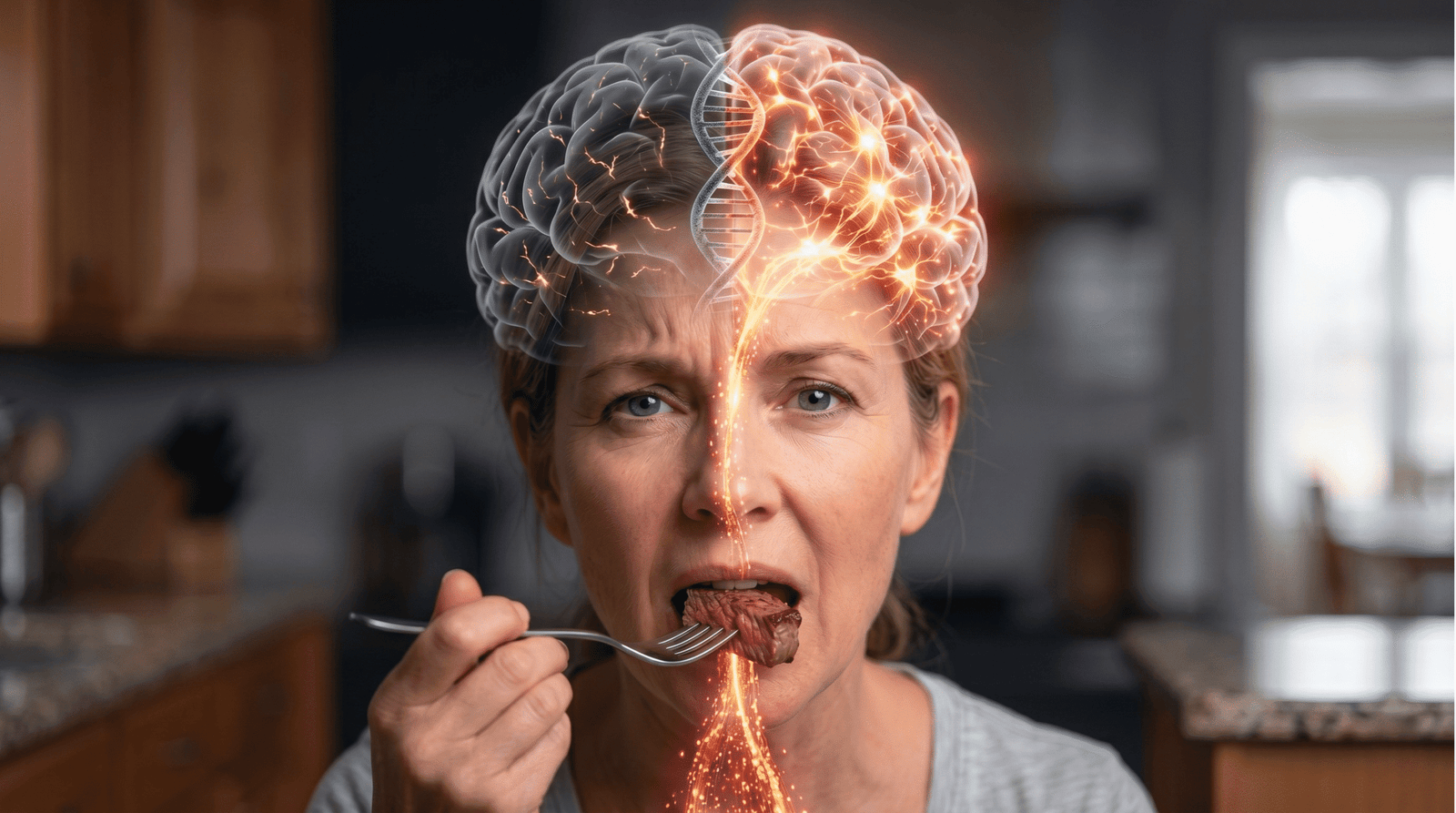


What if I told you that the most common nutritional advice given to people with Alzheimer’s disease might be completely wrong? For years, you’ve probably heard that if you carry the APOE4 gene, you need to cut out red meat and adopt a low-fat, plant-based diet to protect your brain. But what if the science actually points in the opposite direction?
If you recently discovered that you carry one or two copies of the APOE4 gene, it’s natural to feel afraid. This gene is known to be the strongest genetic risk factor for Alzheimer’s disease, and hearing can feel like a life sentence. But I’m here to tell you that your genes are not your destiny. Increased risk does not mean that your fate is sealed. In fact, fascinating new research turns old advice on its head, suggesting that what you eat can profoundly affect this risk, and that meat may just be an important part of the solution, not the problem. (Based on insights from Dr. Brett Sherr)
Key takeaways
- APOE4 is a risk factor and not a guarantee: Carrying the APOE4 gene increases your risk of developing Alzheimer’s disease, but many people who carry the gene never develop it. Your lifestyle is a powerful co-author of your health story.
- Environmental matters: In some non-industrialized societies, the APOE4 gene does not carry the same risk of dementia, highlighting the enormous influence of diet, physical activity and environment on how your genes are expressed.
- Old advice is being challenged: The long-standing recommendation for APOE4 carriers to eat a low-fat, plant-based diet has been called into question by new scientific evidence.
- Meat may be protective: A recent major study found that for APOE4 carriers, higher meat consumption was associated with minimum Risk of dementia, which is in direct contradiction to popular advice.
- Focus on nutrient density: Your brain needs specific, highly bioavailable nutrients to thrive. Unprocessed meats are one of the most efficient sources of important brain nutrients such as vitamin B12, iron, zinc and creatine.
1. What is the APOE4 gene, and why do people worry?
First, let’s break down what we’re talking about. APOE stands for Apolipoprotein E. Think of it as a protein that acts as a little taxi service in your body, responsible for transporting fats and cholesterol. There are three common versions or alleles of this gene: APOE2, APOE3, and APOE4. Everyone inherits two copies, one from each parent.
APOE3 is the most common version and is considered neutral in terms of risk for Alzheimer’s disease. APOE2 is rare and appears to offer some protection. However, it is APOE4 that gets all the attention. If you carry one copy of APOE4, your risk of developing the disease increases Alzheimer’s disease It increases by about two to three times compared to baseline. If you carry two copies, that risk can jump to a scary 8 to 12 times. It can be incredibly scary to hear these numbers, but I want you to hold on to this crucial truth: Risk is not fate. Even among people with two copies of the APOE4 gene, a large number of them live long, healthy lives without ever developing dementia.
So, how does APOE4 exert its influence? Researchers believe that it affects the brain in several ways. It can impair how your brain handles fats and fats, lead to increased inflammation, reduce the brain’s ability to remove the sticky amyloid plaques associated with Alzheimer’s disease, and even disrupt how your brain cells produce energy. Over time, these factors can contribute to cognitive decline. But none of these processes occur in a vacuum. They are all strongly influenced by your environment and, more importantly, what you choose to do every day.
2. Your genes are not your destiny: the power of the environment
One of the most convincing pieces of evidence that your genes don’t hold all the cards comes from studying traditional, non-industrial populations. In fascinating research highlighted by experts like Dr. Tommy Wood, we see that in some hunter-gatherer tribes and other indigenous groups, the APOE4 gene does not appear to have the same ominous association with Alzheimer’s disease. In fact, in some of these populations, it is associated with greater Longevity and better health outcomes.
This begs the question: why? Studies don’t give us one definitive answer, but the evidence all points to their environment and lifestyle. These populations typically engage in much more physical activity, are exposed to more natural sunlight, eat whole, unprocessed foods, and have significantly lower rates of recent metabolic diseases such as type 2 diabetes and obesity. This strongly reinforces the idea that your daily actions and surroundings can radically change how your genes are expressed. You have the power to shape your genetic inheritance through your lifestyle choices. This is not just a hopeful concept. It’s a biological fact.
3. Old advice: Why you were told to avoid meat
For years, the standard advice from many doctors and nutritionists for anyone with the APOE4 gene has been clear: adopt a largely vegetarian, low-fat diet and strictly avoid red meat and saturated fats. The thinking behind this was that since APOE4 affects fat metabolism, eating saturated fat from meat would raise your rate. Bad cholesterol (so-called “bad” cholesterol), thus increasing the risk of dementia.
This advice was based on the broader hypothesis that saturated fat and cholesterol are the primary drivers of heart disease and, by extension, brain disease. The idea was to create a “brain-healthy” diet that was low in anything that could clog your system. However, when we dig deeper into the actual data, especially newer, more robust studies, this assumption begins to break down. The link between dietary saturated fat, cholesterol and dementia has always been weaker than claimed, and new evidence paints a very different picture for APOE4 carriers.
4. New science flips the script: linked meat minimum Dementia risk

This is where things get really interesting. A recent study published in a prestigious journal The JAMA Network is open The researchers looked directly at the relationship between diet and dementia risk in a large group of people, specifically separating out those with the APOE4 gene from those without. The results were astonishing and went against conventional wisdom.
The study reported that among individuals who carried one or two copies of the APOE4 allele, higher meat consumption was associated with increased… minimum Dementia risk. Let that sink in our mind. Not only did eating meat fail to increase risk, as everyone feared, it was actually associated with a protective effect. Now, it’s important to be scientifically honest here. This was an observational study, meaning it showed a correlation, not a direct cause-and-effect relationship. no Prove Meat prevents dementia.
However, what it does do is that meat is unlikely to increase the risk of dementia in APOE4 carriers. It directly challenges the advice that has been given to millions of people. This finding forces us to reconsider the entire framework we have used to think about diet and brain health for this genetically vulnerable group.
5. More evidence: The vegan/vegetarian dementia paradox?
To add another layer to this evolving story, another recent observational study (this one is not specific to APOE4) found that vegetarians have a higher risk of developing the disease. Dementia Compared to their meat-eating counterparts. Specifically, omnivores (those who eat dairy products and eggs) had a 28% higher risk, and vegetarians had a 33% higher risk compared to omnivores.
What was particularly noteworthy in this study was the trickle-down effect: the stricter the avoidance of animal products, the higher the associated risks seemed to be. Again, we must be careful. This is an observational study and does not prove that the diet is vegetarian Reasons Dementia. There can be other confounding factors. But when you put this finding alongside a JAMA study on APOE4 carriers, a strong pattern begins to emerge. It strongly suggests that we need to dismantle the myth that meat is inherently harmful to cognitive health and start asking a different question: What if meat provides something essential that is difficult to obtain elsewhere?
6. Why might meat be good for your brain?
If meat isn’t a villain, can it be a hero? Let’s take a look at why unprocessed meat is so beneficial, especially for the brain that may be more sensitive due to the APOE4 gene. Your brain is an incredibly nutrient-hungry organ, and meat is one of the most concentrated and bioavailable sources of nutrients on the planet.
Meat is full of important brain-building compounds that are difficult to obtain in sufficient quantities from only plant-based diets. These include:
- Vitamin B12: It is absolutely essential for nerve function and cognitive health. It is found almost exclusively in animal products.
- Heme iron: The most absorbable form of iron, it is essential for transporting oxygen to the brain. Iron deficiency is associated with brain fog and fatigue.
- Zinc: A major player in neurotransmitter function and memory.
- Essential amino acids: The complete set of protein building blocks your brain needs to create neurotransmitters like dopamine and serotonin.
- Creatine: It is increasingly recognized for its role in brain energy metabolism and cognitive performance.
For someone with the APOE4 gene, whose brain may already struggle with energy metabolism and nutrient transport, getting these nutrients in their most efficient and usable form can be a game-changer. It is possible that the APOE4 brain is more sensitive to nutrient deficiencies, and a diet that includes meat is simply the most effective way to ensure it gets what it needs to function optimally.
Bottom line: You’re in the driver’s seat
If you carry the APOE4 gene, the underlying message is one of empowerment, not fear. Your genetic makeup does not determine your fate. Evidence strongly suggests that your lifestyle, especially your diet, plays an enormous role in your long-term brain health. Emerging science suggests that the old advice to fear and avoid meat may be misguided. Instead of being harmless, meat may be a vital source of the nutrients your brain needs to stay flexible.
This doesn’t mean you should eat nothing but steak. The takeaway is to focus on a nutrient-dense, whole-food diet and not be afraid to incorporate high-quality animal products. Your brain is a high-performance machine, and it needs excellent fuel. By understanding your unique genetic predispositions and making informed, evidence-based choices, you can take powerful steps to protect your cognitive health for years to come. You are in the driver’s seat.
source: Dr. Brett Shear

