

The HLAA chapter helps create a dynamic hearing loss exhibit in Boston
Written by HLAA Communications Specialist Terry Briere
More than a million annual visitors to the Museum of Science (MOS) in Boston can now learn all about hearing loss. The newest installation in the 195-year-old museum’s permanent Hall of Human Life, “Hearing Loss,” explores aspects from ear anatomy to assistive technology with a variety of interactive components.

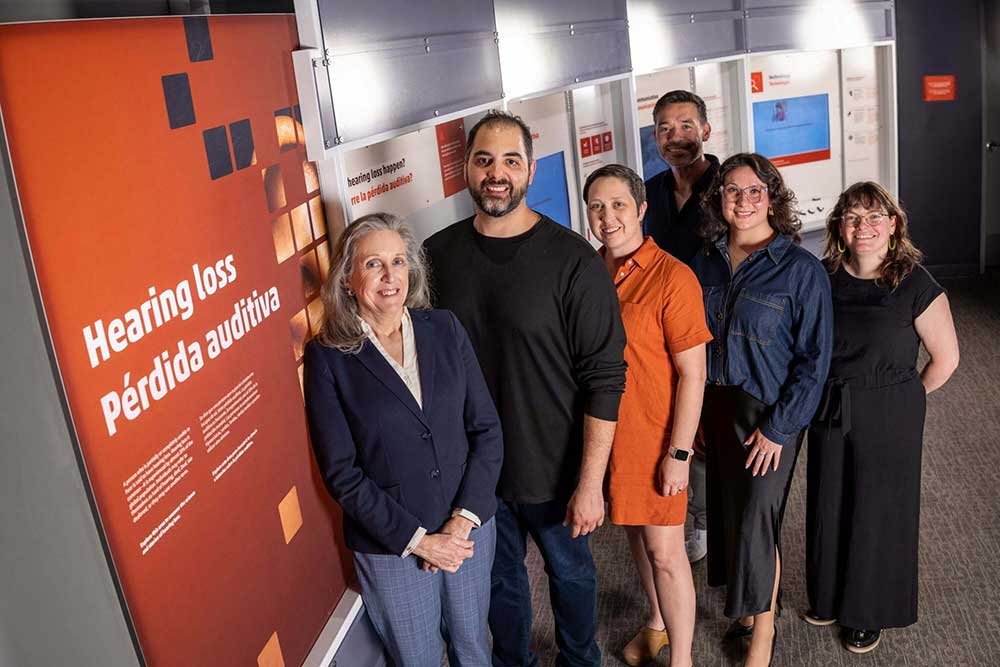
Andrea Kanip and Jonathan Ozick view a component of the MOS exhibition “Hearing Loss” with Sylvie Rosenkalt. Image source: Nick Czarnecki.
This one-of-a-kind exhibit represents a unique collaboration between MOS staff and the local Boston community of the Hearing Loss Association of America (HLAA). As the leading voice for the growing number of Americans with hearing loss and at risk for hearing loss, HLAA empowers millions to thrive through education, advocacy and a nationwide support network. Our 126 local chapters and groups across the United States are an integral part of this mission.
The “Hearing Loss” exhibit was designed and curated by MOS curator and longtime HLAA Boston member Andrea Kanip, who has hereditary progressive hearing loss. Through her involvement with HLAA, Andrea advocates for herself and others with hearing loss, while advising people about hearing assistive technology. She approached the MOS Exhibitions team in 2023 with her vision – an interactive exhibition to educate, inform and eliminate the stigma associated with hearing loss.
“the Hall of human life “It has been a favorite at the museum since 2012, exploring different aspects of objects and what they can do,” says Kate Marcinick, director of exhibition planning and operations at MOS. “The primary goal is to make this information directly relevant to middle and high school students, while matching their curriculum. We have found that there is great value in telling more diverse stories from different perspectives that touch on different aspects of being human. So, when Andrea suggested hearing loss fitting, it was a match made in heaven! Over the course of one year, we developed it together with Andrea, who has been a true partner from the beginning.
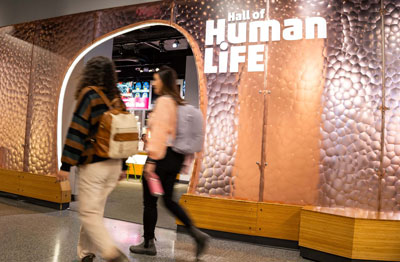
Visitors pass in front of the entrance to the Science Museum’s Hall of Human Life. Image source: Nick Czarnecki.
The project evolved from an early sound booth concept to a larger vision through a 40-person brainstorming session and a dedicated core team of five. As the lead sponsor, Andrea wanted to be closely involved every step of the way. She helped guide the exhibition’s development from start to finish in monthly meetings over 18 months and received weekly updates.
The four stages of this process were:
- Concept development – Brainstorming, goals, objectives and initial research online and via conversations with subject matter experts and people with lived experience of hearing loss. What is the most important thing to communicate with visitors, and what is the best way to engage them?
- Design experience – A prototype was created to test concepts and components with a wide range of visitors, of all ages and backgrounds, as well as a special focus group of local high school students with hearing loss. How does this fit into your stories and experiences?
- Manufacturing and production – Building physical objects and recording/animating video stories – four in the museum and six on the museum website.
- Installation and testing – Place items and make sure everything is working properly before opening it to the public.
According to Kate, this exhibition took longer than usual to allow for the human element, beyond their typical scientific approach. “We have moved carefully to ensure we are creating an authentic experience that reflects the perspectives of many individuals with hearing loss. As a result, we have created something that our associates will be proud of and that our visitors will enjoy.”
MOS Exhibition Items “Hearing Loss”.
- Ear puzzle – Visitors learn about the importance of each part of the hearing system’s functions.
- Hearing safety – A quiz that tests knowledge of noise levels in daily activities, the risks of noise-induced hearing loss, and provides tips for protection.
- communication – A silent, looping video that shows visual communication cues and simulates the experience of someone with hearing loss.
- technology -Visitors explore six types of assistive technology that can support communication, accessibility and independence.
- Theater of the human body – Four moving, personal stories told by people with hearing loss, sharing the everyday challenges and solutions that empower them. Two of these stories are from members of the HLAA Boston Chapter community.
During the second phase, Sylvie Rosenkalt, accessibility coordinator at MOS, reached out to Kerry Sullivan, president of HLAA in Boston, as part of the museum’s search for diverse candidates with hearing loss to share their stories in the exhibit. Among the 10 community members Kerry mentioned were Jonathan Ozick, 40, and Saim Khan, 22, a recent Harvard graduate, both chosen after reviewing numerous applications.
Kerry shares, “MOS is a well-respected organization in the Boston area, so we were very excited to learn about the planned exhibit on hearing loss. It was an opportunity to raise awareness and understanding of hearing loss in our community on a scale beyond what a chapter could do. Imagine our pride when the stories of two HLAA chapter members were featured in the exhibit!”
Jonathan jumped at the opportunity to participate. Since joining the HLAA in 2018, his personal mission has been to reduce stigma and spread awareness about this increasingly common disability. He was born with nerve damage. He is deaf in the right ear and suffers from severe hearing loss in the left. Jonathan experienced discrimination at school, which his video illustrates with an example from sixth grade.
“My goal is to help the community of people with hearing loss through my personal experience,” he says. “I don’t want anyone to go through the same situation I went through.”
Saim, the son of immigrants from Pakistan, was born in Detroit and grew up in Ontario, Canada, before attending Harvard University in Cambridge, Massachusetts. He was diagnosed with sensorineural hearing loss at age 4 and wears a hearing aid in his right ear. Like Jonathan, Sayem suffered discrimination and was sometimes bullied in his regular schools. After attending medical school, his goal is to become an otolaryngologist or other related specialist.

HLAA Boston Chapter member Saim Khan contributed two online videos to the MOS website, as well as his animated story for the exhibit itself. Image source: Science Museum
“I first became interested in science in middle school, and later, in high school, I was mentored by a professor at Wayne State University, researching proteins related to hearing loss and drugs on the market,” he says. “I just earned my undergraduate degree in human developmental and regenerative biology and will be attending Harvard Medical School in the fall (in 2025). Ultimately, I want to develop gene therapy trials to provide alternative treatment options for children with hearing loss.”
The four animated stories in the exhibition are told through:
- Jonathan, about dropping out of school and finding true friendship
- Fasting person trying to listen in the car with friends
- Charlene, who suffered from hearing loss late in life, found connection through a familiar song
- Katie McCarthy, outreach coordinator for the Deaf and Hard of Hearing Program at Boston Children’s Hospital, on sharing a meal while using American Sign Language
The digital component associated with the MOS website, Hearing wellcurated by Caroline Kokosa, MOS Digital Project Manager. It features three individuals, each of whom appears in two videos: Saem, Andre “Dre” Robinson, a DJ who uses American Sign Language (ASL), and a mother, Beth Leipholtz, with her young son, Cobb, who is deaf. This series connects the worlds of assistive technology and deaf culture, showing how they coexist and enrich each other.
Shortly after the Hearing Loss exhibition opened in June 2024, it was shown at a disability rights event in July, where HLAA Boston Chapter It prepared an information table with five of its leaders. July is Disability Pride Month, which celebrates people with disabilities and commemorates the passage of the Americans with Disabilities Act (ADA) in 1990 — in fact, July 26, 2025, marked the 35th anniversary of this landmark civil rights legislation providing public accommodations. HLAA was among the advocacy organizations that supported its passage and provided advice on the accessible communication provisions of the bill.

The communication component of MOS’s “Hearing Loss” exhibit shows visual communication signals with captions on a silent video. Image source: Nick Czarnecki.
MOS features an inclusive, world-class facility and exhibit design that welcomes and accommodates visitors of all abilities. Their accommodations for people with hearing loss include:
- Assistive listening systems (amplified sound).
- Texts and captions for some presentations
- All videos are written in English and Spanish
- American Sign Language (ASL) interpretation and computer-assisted transcription (CART) with two weeks advance notice
- American Sign Language interpretation for select shows on the second Sunday of every month
- All exhibits are subject to testing and feedback from the Accessibility Advisory Committee
The museum is currently exploring other assistive technologies, e.g Auracast audio streaming And xander’s annotation glasses. (Learn more about MOS accessibility.)
Hearing loss is a growing public health crisis that affects people of all ages. More than 50 million Americans (one in seven) have some degree of hearing loss, and many more are at risk. The World Health Organization predicts that up to 2.5 billion people worldwide will suffer from hearing loss by 2050, and that 1 billion young adults are at risk due to unsafe listening practices.
Despite the alarming numbers, many of us still don’t care about our hearing as an important part of our overall health and well-being. Hearing should be tested, protected and treated, which are important messages that the HLAA is spreading nationally. The organization also fights the stigma associated with hearing loss through education, a mission Andrea has undertaken locally in Boston (Read Andrea’s story).
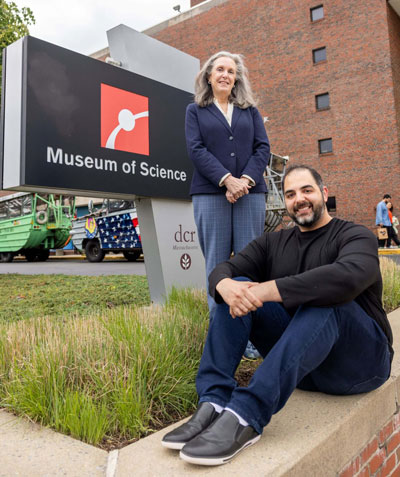
Andrea Kanip and Jonathan Ozick in front of the Outdoor Science Museum sign. Image source: Nick Czarnecki.
“Through my involvement with HLAA and volunteering as a hearing assistive technology counselor, I began to see the many barriers preventing people from seeking help for their hearing loss, which audiologists do not have the time or knowledge to address,” says Andrea. “I realized that information about its causes, associated stigma, technology and other issues needed to reach more people in welcoming public spaces. This inspired me to reach out to the Science Museum.”
Personal stories like Jonathan and Saim’s have the ability to connect more deeply and emotionally with museum visitors, generating empathy in a way that written facts do not. By sharing his story, Jonathan hopes “…we make the world a better place for people with hearing loss, where others understand where we come from and provide reasonable accommodations for accessibility at school and work.”
This unique collaboration with MOS reaches beyond the museum exhibit, it is a powerful community partnership inspired by the local HLAA chapter to change mindsets around hearing loss. The more we work together to integrate hearing loss information into the mainstream, the more together we can reduce stigma and other barriers.

