

What if I told you that some of the most common beliefs about living a long, healthy life are based on outdated science or just plain wrong science? This can be frustrating to hear, but it’s also incredibly encouraging. The beauty of science is that it is constantly evolving. As we learn more, we have to be willing to correct course and abandon old ideas that no longer hold.
When it comes to longevity, this is great news. This means the ability to influence your life and, more importantly, your life healthspanThe quality of your years is much more in your hands than you think. We’ll dive into five key areas where longevity science has taken a sharp turn, debunking common myths and giving you the control you deserve throughout your health journey. (Based on the insights of Thomas Delawer)
Key takeaways
- Your lifestyle choices have a much greater impact on your lifespan than your genetic code.
- It’s not too late to make significant health improvements; Your body can adapt and benefit at any age.
- The benefits of popular nutritional supplements such as resveratrol have been greatly overestimated in humans.
- Contrary to popular belief, even moderate alcohol consumption does not improve life expectancy and can be harmful.
- Calorie restriction is not a one-size-fits-all solution; Its effectiveness is closely related to the quality of your overall diet.
1. Myth: Your genes determine your age

This is perhaps the biggest and most persistent myth of all. We often hear people say things like, “Everyone in my family lived to be 95,” or conversely, “My heart disease It runs in my family, so I’m doomed.” While there is a genetic component to health and longevity, science is now showing us that it’s a much smaller piece of the puzzle than we ever imagined.
Review published in Human genetics Summed it up perfectly. It found that genetic factors account for only about 20% to 30% of the variance in adult lifespan. Think about that. This means that up to 70% to 80% of how long you live is determined by non-genetic factors, in other words, your lifestyle. What is even more remarkable is that as our understanding of the influence of lifestyle increases, the perceived importance of genetics continues to diminish. Every new discovery about the power of diet, exercise, and stress management reduces that 20-30%, putting more and more power back into your hands. This is the best possible news because it means that your future is not written in your DNA. You are the primary author of your life story.
2. Myth: It’s too late to change your habits
Many people feel that if they didn’t establish healthy habits in their youth, the ship has sailed. They think: “I’ve been smoking for 30 years, what’s the point of quitting now?” Or “I’ve never exercised before, it’s too late to start.” Science is here to tell you, loud and clear, that this is completely untrue. It’s never too late to make positive change.
Extensive study in New England Journal of Medicine It looked at more than 200,000 people and the impact of quitting smoking at different ages. The results were amazing. People who quit smoking between the ages of 25 and 34 added about 10 years to their lives. Those who quit smoking between the ages of 35 and 44 regained 9 years. Even those who quit smoking between the ages of 45 and 54 regained 6 years of life. While it is better to quit smoking early, data proves that stopping the harmful habit when… any Lifespan provides a significant benefit that extends life.
The same principle applies to physical activity. We thought that if you weren’t active when you were young, starting later in life offered minimal benefits. We now know that what matters most is your personality Improve your personal baseline. If you move from sitting completely to regular movement, this change is what provides huge health benefits. One study found that going from no exercise to just 150 minutes per week (that’s about 20-30 minutes per day) over five years resulted in a 24% reduction in all-cause mortality. This change is much more impactful than being a lifelong moderate practitioner who never changes his routine. Your body rewards positive transformation, no matter when you start.
3. Myth: Resveratrol is a miracle supplement for longevity
Remember when resveratrol was all the rage? A compound found in grape skins, it has been hailed as a miracle molecule that could extend life, based largely on studies in yeast and mice. The media picked up on the news, and suddenly everyone was talking about the health benefits of red wine.
However, when we look at the human data, the story falls apart. A large study published in JAMA Internal Medicine 783 older adults were followed for years. They measured levels of resveratrol metabolites in the participants’ urine to see how much they were actually consuming through diet and supplements. The researchers then tracked their health, inflammation levels, and mortality. Conclusion? There was virtually no difference in age or rates of heart disease or cancer between those who consumed the highest amount of resveratrol and those who consumed the lowest amount of resveratrol. It also had no effect on inflammatory markers. This is a classic example of why we cannot take the results of animal studies and apply them directly to humans. While some compounds show promise in the lab, you need robust human trials to prove their effectiveness. For resveratrol, longevity The claims simply don’t hold up in people.
4. Myth: A little alcohol is good for you
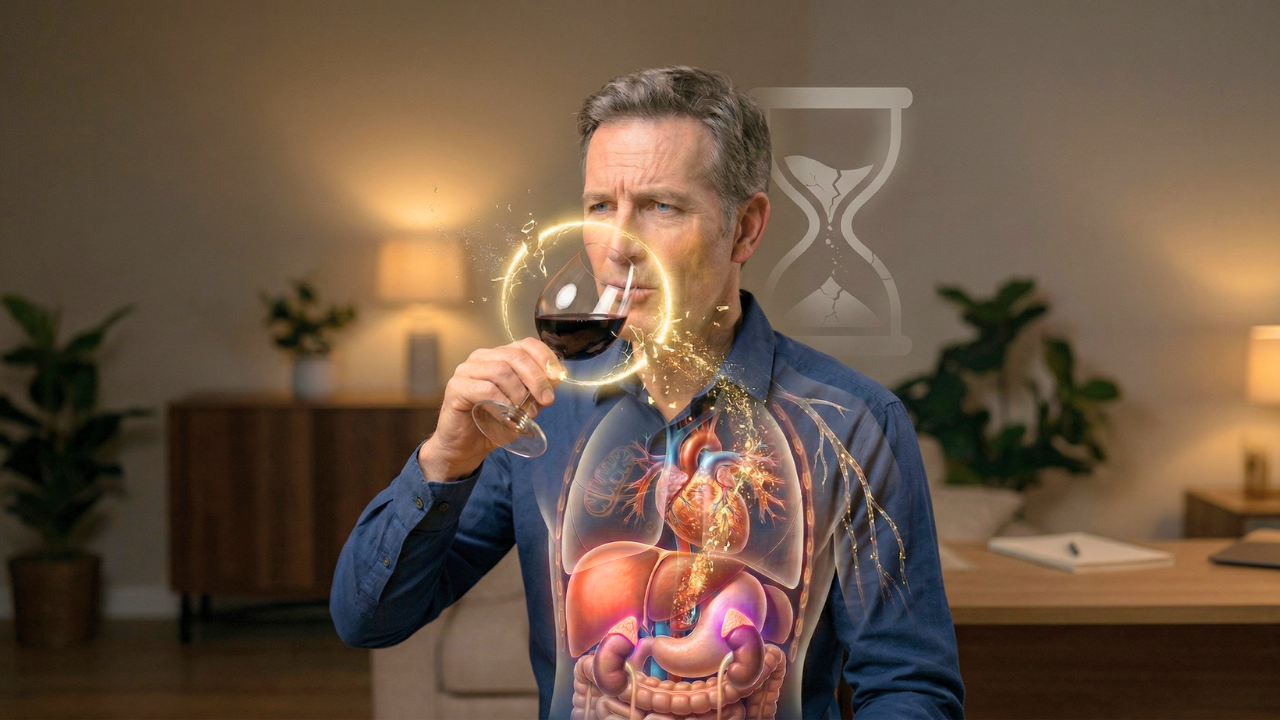
This is one of the most dangerous and well-established health myths. For decades, we’ve been told about the “U-shaped curve” of alcohol consumption, where moderate drinkers supposedly live longer than heavy drinkers who don’t. This has led to the widespread belief that having a glass of wine with dinner is a healthy habit. Unfortunately, those older studies were deeply flawed.
There were two main problems. The first is “reverse causation.” Many of the people in the “non-drinking” group were actually heavy drinkers who had stopped because They have developed health problems. Therefore, their health outcomes were poor not because they were abstaining from alcohol, but because of the harmful effects of alcohol throughout their lives. This skewed the data to make the non-drinking group appear unhealthy. The second problem is that “moderate drinkers” often include people who may only have one or two drinks a year on a special occasion. Combining these light drinkers with the daily drinkers made the moderate group appear much healthier than they actually were.
Now, we have better data. A huge 2023 meta-analysis in The JAMA Network is openwhich reviewed 107 studies involving more than 4.8 million people, debunked this water myth. It found that consuming up to 25 grams of ethanol per day (about one or two standard drinks) had a negative effect. No positive effect On life expectancy. Anything significantly more than that more Risk of all-cause mortality. The science is now clear: alcohol is not a health food, and it will not help you live longer.
5. Myth: Calorie restriction is the ultimate key to longevity
Calorie restriction is a powerful tool, and there is strong evidence that it can improve health indicators and promote longevity. However, it is not everything, and its importance depends greatly on another, more important factor: the quality of the diet.
An interesting study conducted on monkeys highlighted this nuance perfectly. She found that when the monkeys were fed a poor, processed diet, calorie restriction led to significant improvements in health and lifespan. But here’s the rub: For monkeys fed a healthy, whole-food diet, calorie restriction did not provide an additional longevity benefit. This suggests that the main strength of calorie restriction is in mitigating the damage caused by a poor diet.
What does this mean for you? Since most of us live in the real world and eat processed foods from time to time, being mindful of calories and avoiding constant calorie surplus is a very good strategy for health and longevity. However, the ultimate goal should be improvement quality From your food. When you eat a diet rich in whole, unprocessed foods that come from the earth, your body becomes much better at self-regulating. It’s natural to eat when you’re hungry and stop when you’re full, and there’s less need to strictly and forcefully count calories. The focus should always be on quality first.
You are in control
Ultimately, the most important takeaway from all this cutting-edge science is that you’re in the driver’s seat. Your daily choices about what you eat, how you move, and what you avoid have a much greater impact on your health and lifespan than your genes or any supposed miracle supplement. It’s never too late to start, and every positive change you make matters. You have the power to write a long, healthy, vibrant life story, starting today.

